Showing posts with label pride. Show all posts

Saturday, January 15, 2022

Bible Reading Reflection (Job 32-34): Where Does Wisdom Come From?

Where does Wisdom come from?  Most would answer that wisdom comes with age and experience.  However, the Bible says otherwise.  I was reminded of this in a Bible reading from Job.  After listening to a wisdom debate, young Elihu responds:  “I am young in years, and you are aged; therefore I was timid and afraid to declare my opinion to you.  I said, ‘Let days speak, and many years teach wisdom.’ But it is the spirit in man, the breath of the Almighty, that makes him understand. It is not the old who are wise, nor the aged who understand what is right…” (Job 34:6-10).

Young Elihu received no rebuke from God at the end, which seems to indicate that he spoke more rightly than Job’s friends.  Elihu both spoke and demonstrated an important truth.  Wisdom does not automatically come with age.  In fact, there are aged people who are fools and young people who are wise. This is why the book of Proverbs declares, “The beginning of wisdom is: Acquire wisdom; And with all your possessions, acquire understanding” (Prov. 4:7).  Wisdom doesn’t fall into one’s lap with age.  Wisdom doesn’t just happen with age.  One must make a focused and intentional personal investment to grow in wisdom.

The book of proverbs also says, “The fear of the Lord is the beginning of wisdom, and the knowledge of the Holy One is insight.” (Prov 9:10).  The foundation for wisdom is honoring God and knowing him.  One who tries to gain wisdom without God becomes foolish rather than wise. Romans 1 says that who did not honor God or give him thanks “became futile in their reasonings, and their senseless hearts were darkened.  Claiming to be wise, they became fools” (Rom 1:21-22).  Those who increase knowledge without God become crafty instead of wise, which is a form of foolishness.  I am reminded of the quotation from C.S. Lewis: “Education without values, as useful as it is, seems rather to make man a more clever devil.”

In 1 Corinthians, Paul says that it is Christ Jesus “who became wisdom to us from God” (1 Cor 1:30).  However, this wisdom is not the same as the wisdom of the world.  Earlier in the chapter Paul quotes God from Isaiah, “I will destroy the wisdom of the wise, And the understanding of those who have understanding, I will confound” (1 Cor 1:19).  Therefore, Paul went on to ask, “Where is the wise person? Where is the scribe? Where is the debater of this age? Has God not made foolish the wisdom of the world?” (1 Cor 1:20).  If he had been writing in today’s time, he might well have asked, “Where is the university professor?  Where is the politician?  Where is the scientist?  Where is the celebrity?”  These may claim that God’s wisdom is foolishness, but God’s foolishness is wiser than the wisdom of the world (1 Cor 1:25).

Those without the Spirit of God do not accept the things of the Spirit of God because they seem to be foolishness (1 Cor 2:14).  They cannot understand the wisdom of God because the wisdom of God is revealed through the Spirit (1 Cor 2:6-10), which they do not have.  In other words, wisdom is not something we seize by our own ability but is ultimately a gift from God for those who faithfully love, honor, and obey God: “For the Lord gives wisdom; from his mouth come knowledge and understanding” (Prov 2:6).

Fully understanding and appreciating this should help to decrease pride and increase humility.  This prepares our hearts to receive wisdom from God through its various avenues, which include living in his Word (Ps. 119:98; 2 Tim 3:15), listening to godly people who instruct us (Prov 1:8), fear of and obedience to God (Ps 111:10), and personal reflection (Ps 49:3; James 1:22-25). 

Thursday, January 13, 2022

Bible Reflection (Gen. 11): The First Skyscraper

In a recent reading on my daily Bible reading schedule for the year, I once again read the account of the Tower of Babel in Genesis 11.  I used to wonder what the issue was with the people wanting to make a name for themselves.  Was there something wrong with wanting your life and accomplishments to be meaningful and significant?  Was there an issue with working to have a reputation and legacy that lasts for generations?  I also wondered about what the problem was with building a city.  Most of us live in a city, or in proximity to a city.  There are many good things that come from the city.  Even if you live in a remote rural place, you typically get supplies, medical treatment, education, and other useful things from the city.  What was the problem with an impressively tall tower?  Are structures such as the Washington Monument or the World Trade Center somehow evil?

I wonder what was going on in the minds of men as they built a magnificent city with its impressive tower that reached into the heavens in Babel.  I remember reading that the Mesopotamian translation for Babel was “Gate of God,” but the Hebrew translation is “Confusion.”  Did they intended to reach God by building a gate to the heavens?  Was this one of those Ancient Near Eastern towers that archaeologists have discovered with the long, tall stairway all the way up to the top?  If the size and scale of these are impressive by modern standards, I can only imagine how impressive they would have been by ancient standards!

Isn’t it comical then, that even as high and impressive as the tower was, that God still had to come down from Heaven to see what they were doing?  This made me wonder about God’s concern, “Behold, they are one people, and they have all one language, and this is only the beginning of what they will do. And nothing that they propose to do will now be impossible for them.”  I am pretty sure that this was not the omnipotent creator feeling threatened by man’s puny accomplishments.  Perhaps the concern was with the attitude of man.  Through growing in strength, knowledge, and ability, nothing would be “impossible” for man.  They were living life on their own terms.  They even built a tower into the heavens, seemingly to meet God on their own terms as well.  

This is the height of hubris.  The only stairway to Heaven is the one God builds.  I am reminded of the stairway that Jacob saw at Bethel in a vision.  Unlike the Tower of Babel, this stairway touched the earth and actually extended into Heaven with angels ascending and descending on it with God at the top of the stairway.  With this stairway, God showed Jacob that he was with him wherever he went.  This was not something Jacob could have built.  It was a gift from God.

I am also reminded of what Jesus said to Nathaniel when he said, “You shall see heaven open, and the angels of God ascending and descending on the Son of Man.”  This reminds me that the only stairway to God is not one that I can build, but one that Jesus builds for us.  He is the only way to the Father.  I can only come to God humbly on his terms, not my own.  I cannot build my own religion and expect to reach God with it.  This is arrogance and pride, and the Bible says that God is opposed to the proud but gives grace to the humble.

This attitude often expresses itself with words such as, “I know that the Bible says_____, but I don’t accept that.  I believe ________ about God.”  This is what the pride of building a tower into the heavens looks like.  

So, it seems that God’s concern that “nothing that they propose to do will now be impossible for them” was about man’s attitude.  As with the case in Genesis 3 where man tried to be “like God” by doing this without regard to God, man once again did the same thing with the Tower of Babel affair.  Building a tower into the heavens was the start of another man-made religion, which is idolatry.  Instead of magnifying and glorifying God’s name, man tried to make a name for “himself,” which also amounts to idolatry.  The most deceitful form of idolatry is when man makes an idol out of man because it does not look like religion.

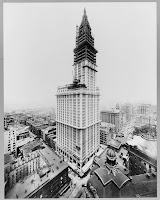
But, if I avoid idolatry and serve God, is it wrong to want to make a name for myself?  People want to be remembered.  It could be a building project, like the Woolworth Tower in Manhattan, which was once the tallest building in the world.  However, even though the name lived on, many people had no idea who Frank Woolworth was.  Whether it is an endowment in the name of a person, an institution, or a building, people want to try and make a name for themselves that lives on.  

I need not worry about making a name for myself.  God is the only one who can make a name for me that counts.  Every now and then, I read a story about how archaeologist have discovered a building or city in the dirt.  Who were they?  What did they do?  What were their names?  How many names have been forgotten throughout human history?  I don’t know, because they have been forgotten.  On the other hand, my name is recorded in God’s book.  Unlike other books or monuments, it will not pass away.  What I do for God in fulfilling his purposes is the only thing of lasting significance.  It doesn’t matter whether people of this earth stand up and take notice and build a monument to my name, because this, like everything else, will rot and pass away.  However, the true treasure in Heaven will never decay or pass away.

Wednesday, February 17, 2021

From Awkward and Embarrassing to Peace and Comfort

Can you imagine the stares?  Could there not have been a more awkward moment?  No one would expect this sort of thing when you have been invited as a guest to dinner.  In Luke 7, Jesus went to Simon's house for a meal.  As he reclined on his elbow and enjoyed the food, he felt something behind him at his feet.  He looked back and saw her.  A woman had come into the house and was kneeling at his feet.  How did she get in here?  I can imagine a hush came over the room as this woman knelt at Jesus' feet.  There were probably looks of disapproval.  Jesus said nothing, so neither did anyone else.  She anointed his feet and the aroma filled the room.  The sounds of her sobs pierced the silence as her tears fell on Jesus' feet.  With nothing else to wipe them off, all she could do was use her hair to dry his feet.  Did she not have any self-respect?  How dare she intrude into the home of decent people during a meal to honor a prophet like Jesus!  The more this went on, the more awkward this became.  There were those in the room who knew who this woman was.  She was not a respectable woman by any means.  She was likely the town tramp.  Simon, the host, was probably embarrassed and disgusted.  I am sure he wondered about Jesus' reaction.  I can imagine the look on his face as he muttered, "If this man were really a prophet, he would know what kind of woman he is allowing to touch him.  She is a.. sinner."  I can imagine Simon was wondering what Jesus would do next about this poor excuse of a human being.


Jesus finally spoke up.  "Simon, I have something to say to you."  I wonder if Simon thought, "Finally!  I was wondering how long he was going to allow this embarrassing situation to continue.  Simon replied, "Say it teacher."  Jesus then tells a story.  “A certain moneylender had two debtors. One owed five hundred denarii, and the other fifty. When they could not pay, he cancelled the debt of both. Now which of them will love him more?”  Simon correctly answered that it was the one who had the larger debt.  Then Jesus does something unexpected.  He contrasts the woman at his feet with Simon at the head of the table, but not in the way he expected.  Simon did not offer water for Jesus' feet, nor give him the customary kiss on the cheek, nor did he anoint him with fragrant oil.  All of this would have been the customary way to honor a guest.   In contrast, the woman wet his feet with her tears, did not stop kissing his feet, and she anointed his feet with ointment.  What a stark contrast!  She showed more honor to Jesus at his feet than Simon did at his head.  She came into the house seeking Jesus in complete humiliation and emptiness.  Jesus acknowledged that she had many sins, but then he forgave all her sins.  The last thing he said to her was, "Your faith has saved you; go in peace." 


Everyone in that room was in need of forgiveness.  It is likely that Simon did not recognize his need.  However, this woman had no defense.  She knew her condition and she knew she needed to get to Jesus.  She intruded into the dining room because she had to get to Jesus.  There was no pride, no hiding behind a veneer of respectability, only the overpowering need to get to Jesus.


I am struck by Jesus' actions. He took an extremely awkward and humiliating situation for the woman and turned it completely around.  He did not shame her the way Simon did.  Instead, he took away her shame. The woman left that day in peace, not humiliation.  Jesus' words shamed Simon.  She treated Jesus better than Simon did.  She humbled herself before Jesus, and he lifted her up.  This was a kind and beautiful thing Jesus did.  One of the things to reflect on is this: How can I be like Jesus in similar situations?