Showing posts with label Jesus. Show all posts

Thursday, February 20, 2025

God's Choice of Judah vs. Joseph

Sometimes the most memorable thing a person will say are his last words.  I can imagine that the final blessing of Jacob to his sons were etched into their minds.  One of the surprising things about his final blessing is some were short, and most were not the most positive of words.   
 

Of his oldest son, Reuben, he said: 


"Reuben, you are my firstborn,
    my might, and the firstfruits of my strength,
    preeminent in dignity and preeminent in power.
Unstable as water, you shall not have preeminence,
    because you went up to your father's bed;
    then you defiled it—he went up to my couch!" (Gen 49:3-4).


Of Simeon and Levi he said:


"Simeon and Levi are brothers;
    weapons of violence are their swords.
Let my soul come not into their council;
    O my glory, be not joined to their company.
For in their anger they killed men,
    and in their willfulness they hamstrung oxen.
Cursed be their anger, for it is fierce,
    and their wrath, for it is cruel!
I will divide them in Jacob
    and scatter them in Israel" (Gen 49:5-7).


Of his youngest son, Benjamin, he said:


"Benjamin is a ravenous wolf,
    in the morning devouring the prey
    and at evening dividing the spoil"  (Gen 49:27).


Due to the dysfunctional activities in the family over the years, most of Jacob’s final words are either short or negative, or both.


However, this is not true of Joseph’s blessing.  Joseph seemed to be a shining star out of all the sons of Jacob.  He exemplified so many of the characteristics a godly man should have.  Even in the face of extreme difficulties, he lived well and died well in the end.  Here are the final words Jacob passed on for Joseph.


 “Joseph is a fruitful bough,
    a fruitful bough by a spring;
    his branches run over the wall.
 The archers bitterly attacked him,

    shot at him, and harassed him severely,
yet his bow remained unmoved;
    his arms were made agile
by the hands of the Mighty One of Jacob
    (from there is the Shepherd, the Stone of Israel),
by the God of your father who will help you,
    by the Almighty who will bless you
    with blessings of heaven above,
blessings of the deep that crouches beneath,
    blessings of the breasts and of the womb.
The blessings of your father
    are mighty beyond the blessings of my parents,
    up to the bounties of the everlasting hills.
May they be on the head of Joseph,
    and on the brow of him who was set apart from his brothers” (Gen 49:22-26).


Based on this, one would think that God’s seed promise to Abraham, Isaac, and Jacob would be fulfilled through Joseph.  However, this is not the case.  The seed promise would be fulfilled through the tribe of Judah, which later produced Jesus, the Messiah.


This is rather interesting.  Not only does Judah not occupy a lot of space in the stories of Genesis, but his portrayal is less than flattering.  In Genesis 37:26-27, it was Judah that concocted the plan to sell Joseph into slavery to get rid of him.  In Genesis 38, Judah’s first two sons were evil enough that God took both of their lives.  This left him with a daughter-in-law that was a widow.  To take care of her, he promised his third son as a husband when he was old enough to marry.  However, he told her to go back home to her father until he grew up!  It became evident that Judah had no intention of keeping his promise to Tamar.  Later, it was Judah that went to what he thought was a prostitute.  It was Judah that had to be backed into a corner by Tamar to keep his word.  Judah was indeed a very different man than his brother, Joseph. 


However, Judah appears to have become a changed man later in his life.  In Genesis 43:8-10, Judah offered himself up personally as a guarantee for Jacob’s favorite son, Benjamin.  In Genesis 44:14-34, Judah had every intention of keeping his word.  When Benjamin was going to be held captive in Egypt, Judah offered to stay in Benjamin’s place.  That Judah did this for his father’s favorite son shows Judah to be a changed man.  He acted in a completely different way concerning Benjamin, Jacob’s favorite son at that time.


Perhaps this is why the only other long and positive blessing Jacob gives is to Judah.  Of Judah, Jacob offered this blessing:


“Judah, your brothers shall praise you;
    your hand shall be on the neck of your enemies;
    your father's sons shall bow down before you.
Judah is a lion's cub;

    from the prey, my son, you have gone up.
He stooped down; he crouched as a lion
    and as a lioness; who dares rouse him?
The scepter shall not depart from Judah,
    nor the ruler's staff from between his feet,
until tribute comes to him;
    and to him shall be the obedience of the peoples.
Binding his foal to the vine
    and his donkey's colt to the choice vine,
he has washed his garments in wine
    and his vesture in the blood of grapes.
His eyes are darker than wine,
    and his teeth whiter than milk” (Gen 49:8-12).  


In this blessing, Jacob referred to Judah as a brave lion’s whelp.  He also declared that the ruler’s staff would not depart from Judah, indicating that a ruler would come from him.  This ruler would be none other than Jesus, the Messiah (Mt 1:3,16), the “Lion of the tribe of Judah” (Rev 5:5).


God’s choice of Judah did not exclude the others from receiving the blessing.  However, only one could have the honor of being the vehicle for fulfilling the seed promise.  Why Judah?  Despite the change in his life, he does not stand out in exemplary character the way Joseph did.  This appears to have changed in Judah’s later life, which is a reminder that a man can choose what kind of man he is going to be.


However, God’s choice is not based on our actions, but his grace and favor.  Romans chapter 9 discusses how God’s choice is based on his grace and mercy, not on how much someone has done right or wrong.  It clearly states, “… it depends not on human will or exertion, but on God, who has mercy” (Rom 9:16).  Whether it is choosing the younger, choosing the least, or even choosing the one who has less than exemplary characteristics, it is always according to God’s grace. 


We are God’s chosen because of his mercy.  Spending time in meditation on this will help to displace the pride that God is so opposed to.  Prayerful reflection on this should cause our pride to deflate and our humble thanksgiving to inflate.  This should increase our patience, compassion, grace and mercy for others. 

Monday, October 23, 2023

Giving Up Leads to Fruit

I have been spending some time reflecting on harvest during the fall season.  With all of the fall community celebrations along with apples, fruits, preserves, there is an atmosphere of celebration in enjoying the fruit of labor.

I am reminded of something Jesus said during the fall season of his life.  In the upper room, he had his final Passover with this disciples and friends.  Soon, he would be the new Passover.  There, he instituted a new, weekly Passover when he transformed the meaning of the cup and bread.

His choice of words bears some reflection.  In Matthew 26:27-29, he said, “And he took a cup, and when he had given thanks he gave it to them, saying, “Drink of it, all of you, for this is my blood of the covenant, which is poured out for many for the forgiveness of sins. I tell you I will not drink again of this fruit of the vine until that day when I drink it new with you in my Father's kingdom.” 

When Jesus gave them the cup of Passover wine, he assigned new meaning to it.  For wine to be associated with the new covenant evokes the common scriptural images of a bountiful harvest that comes because of the favor of the Lord.  Part of this imagery includes the joyful abundance of wine (Isa 25:6; 55:1-2; Hos 2:21-22; Hoel 2:18-24; Amos 9:13-14).  For years in my Bible reading, I did not notice the abundance of wine as a sign of God’s favor.  This way probably because of the negative connotations associated with strong drink.  However, in these cases it is not about drunkenness, which the Bible condemns, but about an abundant harvest that is a sign of God’s favor due to human faithfulness.  For example, in a message of hope for future restoration, Isaiah 25:6 says, “On this mountain the Lord of hosts will make for all peoples a feast of rich food, a feast of well-aged wine, of rich food full of marrow, of aged wine well refined.”  On the other hand, the lack of wine is a sign of God’s disfavor and judgment to due sin (Jer 48:33; Hos 2:8-9; Joel 1:10; Hag 1:10).  For example, due to Israel’s consistent sin, in Hoses 2:9 God said, “Therefore I will take back my grain in its time, and my wine in its season.”  (This may offer a subtle message that God’s favor has returned when Jesus turned water to wine in John 2.)

Jesus’ choice of words also bears reflection.  Jesus could have said, “wine,” and all of the above images related to wine would still be there.  However, he said, “fruit of the vine” and connected it to his blood which he would shed for our sins.  The connection of wine, fruit, his blood, and his death is a powerful reminder for us.  When he shed his blood on the cross, his death bore abundant fruit.  It was the restoration of God’s favor, expressed in a new covenant that has been inaugurated by the blood of Jesus, shed on the cross.  This calls to mind when Jesus announced his impending death with this explanation in John 12:24: “Truly, truly, I say to you, unless a grain of wheat falls into the earth and dies, it remains alone; but if it dies, it bears much fruit.”  Truly, Jesus’ death bore much fruit. 

It occurs to me that we also need to “die” in order to bear fruit for God.  His death, burial, and resurrection is the pattern for our new life in him, which we demonstrated by being buried with him in baptism, dying to ourself, and being raised up as a new person in him (Rom 6:1-7).  When we truly die to ourselves in him, our death will produce abundant fruit.  The only way to bear fruit is in giving up of ourselves.  

One practical example of this in action comes from 2 Corinthians 8:1-5; 9:6-11 and also bears reflection.  In pointing out some of the poverty-stricken brethren’s overwhelming generosity in giving to needy brethren, the text goes on to say this. “He who supplies seed to the sower and bread for food will supply and multiply your seed for sowing and increase the harvest of your righteousness. You will be enriched in every way to be generous in every way, which through us will produce thanksgiving to God” (2 Cor 9:10-11).  The self-sacrificing spirit in the name of Christ will not only produce an abundant harvest of thanksgiving to the Lord, strengthening the faith of the brethren, but God will also continue to bless with more seed for more harvests!


Tuesday, October 03, 2023

It IS the Lambie!


Some of us were on a roll quoting lines from the comedy movie, “The Quest for the Holy Grail.”  In one scene, Tim the Enchanter leads King Arthur and his knights to the cave of a terrible and vile monster.  Tim had terrified them by warning, “Death awaits you all with nasty, big, pointy teeth!”  The men arrived to find the area in front of the cave littered with bones and broken armor.  “There he is!” Tim announced. “Where? Behind the Rabbit?” Arthur asked.  “It IS the rabbit!” answered Tim.  At this point, a sense of relief and ridicule came from Arthur and his men.  Even though Tim pointed out, “Look at the bones!” they were no longer convinced. When Arthur ordered one of his men to get the rabbit, it suddenly lunged and killed him along with two more of Arthur’s men before they ran away.


The scene brings to mind another scene that is neither comedic nor ridiculous.  In Revelation chapter 5, John saw God on his throne holding a scroll that no one was worthy to open except the Lion of the Tribe of Judah who had conquered.  John looked at the Lion, but “saw a Lamb standing, as though it had been slain…” (Rev 5:6).  There are several words in Greek that can for “lamb.”  The one in this verse is interesting.  “Arnion,” is a diminutive form of “aren.”  The “ion” at the end of a Greek word makes it diminutive.  An example of an English diminutive is “let,” as used in words like piglet, eyelet, droplet, booklet, starlet, or kitchenette.  Other examples are duckling, gosling, cigarette, diskette, doggie, kitty, and so forth.  The Greek word “arnion” could be rendered as “lambling,” “lambette,” or “lambie.”


I have been reflecting on what “lambie” communicates.  This is not just a lamb that John sees, but a little lamb.  It seems mild and harmless on the surface.  However, the text refers to the “lambie” as the “Lion of the Tribe of Judah,” which communicates agility, power, and strength.  This lambie was slain, but is now standing, never to taste of death again.  At one point, when the commanders and kings of the earth were trying to hide from judgment, they cried out to the rocks and mountains to fall on them and hide them “from the face of him who is seated on the throne, and from the wrath of the lambie, for the great day of their wrath has come” (Rev 6:16-17).  In Revelation 19, the lambie appears as the fiery eyed warrior riding on a white horse as King of Kings and Lord of Lords wearing a robe with blood, wielding a sword from his mouth to strike the nations and has the armies of Heaven following him!


This “lambie” reminds me of the nature of God’s power.  It is often perceived as weakness, especially by those who do not have eyes to see and ears to hear.  With hearts that see, we know that “he was crucified in weakness, but lives by the power of God” (2 Cor 13:4). We understand that “power is perfected in weakness” (2 Cor 12:9).  We recognize that “the weapons of our warfare are not of the flesh, but are divinely powerful for the destruction of fortresses” (2 Cor 10:4).  God has demonstrated this through people like Gideon (Jud 7:1-22), Young David (1 Sam 17:44-51), Jehoshaphat (2 Chr 20:20-25), and others.  I am reminded of something Jimmy Allen, one of my instructors, used to say.  “One man with God always makes a majority.”  


The power of God is not behind the lambie, it IS the lambie!


Friday, December 23, 2022

The Manger

When I was growing up, it did not dawn on me that nativity scenes were at attempt to take several biblical events which may span over a two year period and compress them into one single scene.  Why?  As I understand it, the original reason for putting together a nativity scene in the 13th century was for a visual teaching tool to tell the story of Jesus.  In light of the fact that a larger portion of the population would have been illiterate, it makes sense to use this method as a teaching tool.

I have been spending time reflecting on the manger.  I prefer the word, “manger” because “feeding trough” sounds too crude.  Yet, this is exactly what it was.  Was it made of wood, or stone, which would have been more typical of that time?  I think a more important thing to consider is that this was not something that was designed to be a baby bed.  The one whom Gabriel said would be called, “holy” and “The Son of the Most High” who would sit on the throne of his father David in a kingdom that would have no end, did not have a bed of his own.  One might expect a royal birth to take place in a palace with a monogramed bed.  But this is not how God chose to come into the world.  

I am sure that Mary, in her motherly care, made the manger clean and suitable with whatever bedding she had in order to properly care for this precious baby.  It may have looked as nice and inviting as we see in many of the nativity scenes due to her attentiveness as a good mother.  However, it was still not a baby bed.

This reminds me of something Jesus said during his ministry.  In Luke 9:57, someone told Jesus that he would follow him wherever he went.  I am not sure what type of life this man thought he was volunteering for, but Jesus made it clear what it would look like to follow him.  Jesus responded with, “Foxes have holes, and birds of the air have nests, but the Son of Man has nowhere to lay his head.”

Where was the palace of the Messianic King?  Where was his bed chamber?  Where was his royal pillow?  It was nowhere on earth.  Unlike wild animals that have their dens, he had nowhere to lay his head.  This was foreshadowed on the day he was born.  Even in his birth, there was no permanent place to lay his head.  He had to be laid in a manger.  Throughout his life, there continued to be nowhere to lay his head.  Even in his death, there was nowhere to lay his head.  Joseph Arimathea provided a place for Jesus to lay his head in death.  But he did not need a permanent place to lay his head in death.  He wasn’t there very long.  In three days, he sat up and walked out of that tomb, never to return.

Once he completed his ministry, he went back to his true home, which is with the Father in Heaven.  This world was not his home, he was just passing through.  The same is true for us.  When we follow Jesus, we have no permanent place to lay our head on this earth, whether in life or in death.  Our home is Heaven.  Think about these things the next time you see a manger and use it to tell the story of Jesus.


Thursday, February 17, 2022

God's Love as Phileia

I pulled out my Greek concordance to look up the words for love in the New Testament.  The two most common words for love in the New Testament are agape and phileia.  I used to think of agape as distinctly Christian love, and phileia as a love based on feeling and therefore inferior and not godly.  When I discovered that this was not the case, it was an eye opener for me.  Phileia, or a form of it appears numerous times in relation to God’s love or the love that we are to have for others. 

Titus 3:4-5 says, “But when the goodness and loving kindness of God our Savior appeared, he saved us,…”  loving kindness is philanthropia, which literally means love for mankind and is the origin of our English word philanthropy.  God’s love for man, which led to the cross is the ultimate philanthropy.  There is no love for mankind like the love of God.

In John 15:13-14, Jesus said, “Greater love has no one than this, that someone lay down his life for his friends. You are my friends if you do what I command you.”  Friend is philos.  The greatest love one can show for his philoi is to lay down his life for them, which is what Jesus did.  If his people follow his commands, Jesus calls them philoi.  How amazing is that that the creator and Lord calls human beings friends!  This indicates the type of love that our Lord has for his people.

Romans 12:10 says, “Love to one another with brotherly affection.  Outdo one another in showing honor.”  Love here is philostorge, a combination of phileia (love/affection) and storge (family love).  Brotherly affection is philadelphia, which means brotherly love.  We are called to have familial affection for one another.  That means that we must get along and like each other.  This may seem impossible, but I can remember siblings who could not stand each other.  The parents’ solution was to make them hold hands for several days and do everything together.  It was not acceptable that they had disdain for each other.  If that is the way it is with a physical family, how much more so would this be for the family of God?  After all we are blood, but it is blood that goes for beyond this life.  We are related by the blood of the Son of God who shed it in order to adopt us into God’s family. 

Romans 12:13 says to “Contribute to the needs of the saints and seek to show hospitality.”  Hospitality is philoxenia, which literally means, “strangerly love.”  Not only are we to show brotherly love to our brethren, we are also to show strangerly love to the stranger.  This implies a level of kindness and compassion that we see demonstrated in Jesus as he welcomed people from all walks of life, whether they tax collectors or pharisees.   

Several passages tell us to greet each other with a holy kiss (Rom 16:16; 2 Cor 13:12; 1 Thess 5:26; 1 Pet 5:14).  Kiss is philema, which is in the same class of words as phileia.  As I reflect on this, it occurs to me that this expression seems to be much more intimate than our typical handshake.  But even though this was a typical cultural expression for that time, the word, “holy” indicates that this is not just the typical kiss of greeting, but is special.  Our relationship with each other in the family of God is different than associations we have with those outside.  We greet each other with holy tokens of affection because we have been sanctified and adopted by God to be his family.

Looking at these uses of phileia alongside the description of agape in 1 Corinthians 13 seems to indicate a lot of overlap between agape and phileia.  I am reminded of the conversation between Jesus and Peter at the end of the Gospel of John.  When Jesus asked Peter, “Do you love (agapao) me?”  Peter responded with “Yes I dearly love (phileo) you!”  Peter wanted to use a stronger word of affection when he responded to Jesus.  The text says that Peter was grieved when Jesus asked a third time, “Peter, do you love (phileo) me?”  Phileia and agape do not seem to have a sharp difference in meaning from each other. 

This has caused me to reflect on the nature of love.  I remember a time when I used to think, “I have to love you, but that doesn’t mean I have to like you!”  This came from the mistaken idea that love, specifically agape, had nothing to do with emotion or liking someone.  I now see the ludicrous nature of trying to love without any kind of affection.  The instructions to love in the passages above seem to indicate just the opposite.  We are not called to like someone, but are called to love, which is much deeper than like. 

Sunday, January 02, 2022

Where Do You Start?

A question occurred to me as I was considering the four different Gospel accounts of Christ.  Many do not realize that the typical Nativity Scene consists of several biblical accounts compressed into one scene.  Part comes from the book of Matthew and part from the book of Luke.  Rather than occurring on the same night, it is likely that some of these stories occurred in different months.  

The question that occurred to me is this:  In telling the story of Jesus, where do you start?  Matthew begins with Jesus’ lineage through David back to Abraham, and then moves to the announcement to Joseph, worship from the Magi, and the conflict with Herod.  Luke starts with the announcement of the coming of the birth of John the Baptist, then moves to the announcement of the coming birth of Jesus to Mary.  After the account of Jesus’ birth in Bethlehem, Like gives the account of the worship of Jesus by the shepherds.   Mark, on the other hand, skips over his birth stories and begins with the start of Jesus’ public ministry.  In contrast, John begins with who Jesus was before his birth, then moves from there to the testimony of John the Baptist.  The four Gospels all begin quite differently, focusing on different aspects of Jesus and his arrival.  There have been those who have noted that these differences of emphases likely stems from who the original recipients were.  How and where the Gospel writers began depended on who they were telling the story to.  

This reminds me of another account from Acts 8, where Philip comes across an Ethiopian Eunuch on the road to Gaza reading from Isaiah 53, “Like a sheep he was led to the slaughter and like a lamb before its shearer is silent,…”  The Ethiopian did not understand the passage, so Philip “…opened his mouth, and beginning with this Scripture he told him the good news about Jesus” (Acts 8:35).  In this case, Philip began with Isaiah 53 and told the Gospel of Christ, which would have included his death, burial, and resurrection.

On the other hand, Paul began at yet a different place when he spoke to a group of Philosophers on Mars Hill in Acts 17.  Beginning with philosophical truth that lined up with biblical truth, he began with God and his creation of all things, especially man.  He then taught the necessity for repentance and the coming judgment by Jesus whom God raised from the dead.   

All of these demonstrate that it is important to consider who you are teaching so you can know where best to start in teaching the Gospel.  More importantly, these also demonstrate that you must know where to end up in the teaching of the Gospel.  Even though the telling of the Gospel begins in different places, they always end in the same place.  In fact, if you lay the four Gospels side by side, you will notice that they all come into remarkable sync when it comes to the arrest, crucifixion, and resurrection of Christ.  His death for our sins, burial, and resurrection is what is of “first importance” according to what Paul wrote in 1 Corinthians 15:3-4.  

However we begin, it is imperative that we move to the Gospel of Christ, which at its core involves the death, burial, and resurrection of Jesus the Messiah for our sins as well as his requirement that we, in repentance, accept him as Lord and Christ.  This involves commitment to him as his servants when being buried with him in baptism to put to death the old man so that we can be raised with him as a new creature that is redeemed, reconciled and reforming into the image of Christ.  

Saturday, December 25, 2021

A Reminder from a Christmas Commercial

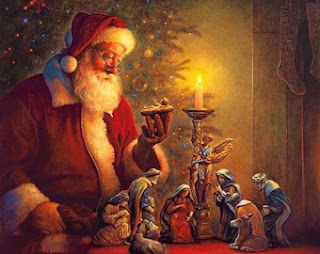
I still remember that commercial from 40 years ago.  I don't remember what it was supposed to have advertised, but I remember the message.  It began with Santa Claus laughing his "Ho! Ho! Ho!" around a living room that was filled with Christmas decorations.  He began to empty his big of brightly wrapped gifts, then paused by the end table to enjoy the cookies and milk that were left out for him.  After some more jolly laughing he stopped at looked at the Christmas tree.  At once, his laughter stopped.  The jolly smile slowly left his face as it was being replaced by a look of deep contemplation.  The camera angle changed and showed that he was staring at a small Christmas ornament.  Inside the clear Christmas ornament was a nativity scene.  The camera zoomed in and focused on the nativity scene as the image of Santa Clauses look of quiet reflection went out of focus. 

I understand what the creators of that commercial were trying to do.  Even forty years ago, there were those who were complaining about the crass commercialism of Christmas.  The fast pace lights, glitter, music, and bustling sounds of holiday activity along with its price tags replaced the simply and silent wonder of divinity becoming flesh.  I have heard people speak of putting "Christ" back into "Christmas."  I have also heard people defiantly wishing people a "Merry Christmas" rather than "Happy Holidays."  There is understandably a desire to hang on to the baby Jesus and not let him get swallowed up.

But is this actually what's happening?  What does it mean to put "Christ" back into Christmas?  Are we talking about being able to say "Merry Christmas" without any repercussions?  Are we talking about more religious decorations and nativity scenes?  Are we talking about children singing Joy to the World rather than Jingle Bells for the school winter program?  How important would all of this be to Jesus?  It seems to me that a lot of this from the past was cultural window dressing.  It was a veneer of religiosity for the holiday season.  I think we all recognize very clearly what Jesus thought of this sort of thing from his Sermon on the Mount in Matthew chapter 7.

This worry about Jesus being swallowed up reminds me of a passage in the book of Revelation.  Here is what the birth of Christ looked like from a cosmic perspective.

"And the dragon stood before the woman who was about to give birth, so that when she gave birth he might devour her child. 5 And she gave birth to a son, a male child, who is to rule all the nations with a rod of iron; and her child was caught up to God and to His throne" (Rev 12:4-5).

The dragon, the serpent of old who is called Satan and The Devil, tried to swallow up the child.  However, the child was caught up to God and his throne.  We know that Jesus died for our sin, was buried, rose from the grave, according to 1 Corinthians 15:1-4, and we know that he ascended to the heavens, according to Acts 1:9.  1 Corinthians 15:25 tells us that he now reigns in his Kingdom, which is in us, his people, according to Luke 17:21, and will do so until the last enemy, which is death, is destroyed.

Neither Satan nor the culture can swallow up the Christ.  What is important is not putting Christ into Christmas, but putting Christ into our hearts.  Jesus' goal was not putting his name on a day for the calendar, but his name in our hearts so that every day is for him.

Wednesday, February 17, 2021

From Awkward and Embarrassing to Peace and Comfort

Can you imagine the stares?  Could there not have been a more awkward moment?  No one would expect this sort of thing when you have been invited as a guest to dinner.  In Luke 7, Jesus went to Simon's house for a meal.  As he reclined on his elbow and enjoyed the food, he felt something behind him at his feet.  He looked back and saw her.  A woman had come into the house and was kneeling at his feet.  How did she get in here?  I can imagine a hush came over the room as this woman knelt at Jesus' feet.  There were probably looks of disapproval.  Jesus said nothing, so neither did anyone else.  She anointed his feet and the aroma filled the room.  The sounds of her sobs pierced the silence as her tears fell on Jesus' feet.  With nothing else to wipe them off, all she could do was use her hair to dry his feet.  Did she not have any self-respect?  How dare she intrude into the home of decent people during a meal to honor a prophet like Jesus!  The more this went on, the more awkward this became.  There were those in the room who knew who this woman was.  She was not a respectable woman by any means.  She was likely the town tramp.  Simon, the host, was probably embarrassed and disgusted.  I am sure he wondered about Jesus' reaction.  I can imagine the look on his face as he muttered, "If this man were really a prophet, he would know what kind of woman he is allowing to touch him.  She is a.. sinner."  I can imagine Simon was wondering what Jesus would do next about this poor excuse of a human being.


Jesus finally spoke up.  "Simon, I have something to say to you."  I wonder if Simon thought, "Finally!  I was wondering how long he was going to allow this embarrassing situation to continue.  Simon replied, "Say it teacher."  Jesus then tells a story.  “A certain moneylender had two debtors. One owed five hundred denarii, and the other fifty. When they could not pay, he cancelled the debt of both. Now which of them will love him more?”  Simon correctly answered that it was the one who had the larger debt.  Then Jesus does something unexpected.  He contrasts the woman at his feet with Simon at the head of the table, but not in the way he expected.  Simon did not offer water for Jesus' feet, nor give him the customary kiss on the cheek, nor did he anoint him with fragrant oil.  All of this would have been the customary way to honor a guest.   In contrast, the woman wet his feet with her tears, did not stop kissing his feet, and she anointed his feet with ointment.  What a stark contrast!  She showed more honor to Jesus at his feet than Simon did at his head.  She came into the house seeking Jesus in complete humiliation and emptiness.  Jesus acknowledged that she had many sins, but then he forgave all her sins.  The last thing he said to her was, "Your faith has saved you; go in peace." 


Everyone in that room was in need of forgiveness.  It is likely that Simon did not recognize his need.  However, this woman had no defense.  She knew her condition and she knew she needed to get to Jesus.  She intruded into the dining room because she had to get to Jesus.  There was no pride, no hiding behind a veneer of respectability, only the overpowering need to get to Jesus.


I am struck by Jesus' actions. He took an extremely awkward and humiliating situation for the woman and turned it completely around.  He did not shame her the way Simon did.  Instead, he took away her shame. The woman left that day in peace, not humiliation.  Jesus' words shamed Simon.  She treated Jesus better than Simon did.  She humbled herself before Jesus, and he lifted her up.  This was a kind and beautiful thing Jesus did.  One of the things to reflect on is this: How can I be like Jesus in similar situations?


Sunday, December 20, 2020

The Shepherd and The Sheep

Oh the irony of the upside-down birth of Jesus in Luke 2!  After hearing that the long-awaited Savior had been born, the angel told the shepherds of the sign that this is Christ the Lord.  They would find the baby wrapped in swaddling clothes laying in a manger.  The first part of the sign, while not anything unusual, evokes thoughts of not only the beginning of his life, but the end of his life.  At the end of his life, he was wrapped again but placed in a borrowed tomb rather than a manger.  We know that in both cases, he did not remain there, but arose to perform his redemptive ministry.  

The second part of the sign was highly unusual.  He was placed in a manger, where livestock may have eaten before.  This may remind us that Jesus is the bread of life, and that we have no life apart from him.  But this scene seems too domestic and mundane for the King and Lord.  What a contrast to the earthly king who was living in a palace.  As I reflected on this, I wrote down the phrase, "Domestic Divinity."  I do not know if I had heard this phrase before, or if it just appeared in my thoughts.  There cannot be a more domestic scene than this.  When people put up nativity scenes, what strikes me is how domestic they often appear.  I realize that nativity scenes try to compress several stories about Jesus into one scene, but historically, the Magi do not belong there because they came later.  The manger, barn, animals, and shepherds make for a very mundane and domestic scene.  Yet God typically glories in the mundane and the ordinary.

This scene from Luke two reminds me of several passages.  In Zechariah 10:2, God said, "2 For the household gods utter nonsense, and the diviners see lies; they tell false dreams and give empty consolation. Therefore the people wander like sheep; they are afflicted for lack of a shepherd."  A recurring problem was the lack of spiritual and moral leadership in Israel.  Kings, false prophets, priests, and fathers often turned to false gods and led the people away from God.  Without proper shepherding, the people were devoured.  The people were sheep without a shepherd.  

What was God's plan for this?  In Ezekiel 34, God condemned the leaders, whom he referred to as shepherds, for not exercising spiritual and moral leadership.  The result of their failure was the scattering of the sheep.  They had become prey to predators.  God then declares in verses 11-12, "For thus says the Lord GOD: Behold, I, I myself will search for my sheep and will seek them out. As a shepherd seeks out his flock when he is among his sheep that have been scattered, so will I seek out my sheep, and I will rescue them from all places where they have been scattered on a day of clouds and thick darkness."

God fulfills this promise in Christ.  In John 10:11, Jesus declares that he himself is the shepherd.  He said, "I am the good shepherd.  The good shepherd lays down his life for the sheep." Jesus came to those who were like sheep without a shepherd to save and care for them.

What an irony, then, that the first to tell of the coming of Jesus were literally shepherds.  These shepherds, whose job was to care for and watch over the sheep, came to the barn and saw the lamb of God.  The lamb of God is the good shepherd.  The lamb has become the shepherd, and the shepherds have become the sheep!

This reminds me, that even though I benefit from fellowship and leadership from people, I must let nothing take the place of the leadership of the good shepherd.  The people had their shepherds, but despite this, Jesus saw in Matthew 9:39 that they were like sheep without a shepherd.  Only Jesus can lay down his life for his sheep and take it up again.  Only Jesus can renovate our hearts through the Spirit as we submit to him.  Only Jesus can redeem us and give us life more abundantly.  

Sunday, November 29, 2020

Would Jesus Wear a Mask?

Would Jesus wear a mask? I saw this question a couple weeks ago in an online article. I understand where the question is coming from. The author pointed out that Jesus looked out for other’s people interests and poured himself out for others and that we should do the same.

I understand why I wear a mask. But why would Jesus wear a mask? Would it have been to prevent him from being infected by someone? Was it to prevent himself becoming a carrier of a sickness? Becoming sick or a carrier is what happens to other human beings. However, Jesus was not just a son of man, he was The Son of Man and The Son of God.

For this reason, contact with Jesus had a very different result than contact with someone else. In Matthew 8:14-15, it says, “And when Jesus entered Peter's house, he saw his mother-in-law lying sick with a fever. He touched her hand, and the fever left her, and she rose and began to serve him.”

People came from all over just to touch Jesus. Mark 9:53-56 says, “When they had crossed over, they came to land at Gennesaret and moored to the shore. And when they got out of the boat, the people immediately recognized him and ran about the whole region and began to bring the sick people on their beds to wherever they heard he was. And wherever he came, in villages, cities, or countryside, they laid the sick in the marketplaces and implored him that they might touch even the fringe of his garment. And as many as touched it were made well.”

Jesus left the safety of Heaven and entered into our infected world. Rather than himself becoming infe
cted and spreading it to others, Jesus did just the opposite. Jesus did not infect anyone, but “exfected” them. In the NRSV, Isaiah 53:4 says, “Surely he has borne our infirmities and carried our diseases.” Romans 5 and 1 Corinthians 15 say that sin came into the world through the first Adam, but that healing and life came through the last Adam, which is Christ. As the Azazel bore the sins out of the camp and away from the people on the day of Atonement, so did Christ carry our sins away as far as the east is from the west. In fact, one of the words translated “forgive” in Hebrew literally means “to carry,” which is what Jesus does for us at the cross and the empty tomb. His blood does not infect, it disinfects through faith. He is the carrier of the cure, not the disease.

I am reminded of the time Jesus breathed on his Apostles and said, “receive the Holy Spirit.” His breath does not weaken and bring death, his breath strengthens and brings life. Through Christ, there ultimately will no longer be any death, mourning, crying or pain.

As a result, we no longer have a spirit of fear, but of power, love, and self-discipline. We are able to be cautious and prudent from a place of love rather than fear. Love moves us to consider risks in a different way than fear does. When it comes to serving in the name of Christ, we see the greater risk in doing nothing rather than serving in the way Christ did when he left Heaven. We stand in the company of Christians who minister to the sick and dying while the rest are fleeing in fear. Like many early Christians, we see it as a type of martyrdom that expresses devotion and love.

Unlike other human beings, Jesus did not need to wear a mask. Thank you Lord for Jesus, whose blood bore our sins away, and whose breath brings us life.

Thursday, December 19, 2019

When the Magi Became Wise Men

I wonder how jarring the second chapter of Matthew might have been for the Jews who first read this Gospel.  The first act of worship toward Jesus came from a group of gentile magicians.  The magi were not kings, nor were they "wise men."  Our word "magic" is related to the word, "magi."  Magi were practitioners of magic.  History has embellished their identities and tried to sanitize what they were.

These are not the only magoi mentioned in the Bible.  Looking at the other magoi helps to get a better picture of what manner of people they were and how they would have been viewed by the Jewish population.

There are two other magoi in the New Testament mentioned by name.  The first is Simon in Acts 8.  Simon the magician practiced the magic arts, and seemed to be interested in acquiring the ability to perform miracles by the Spirit so he could add that to his bag of tricks.  The second magos in the New Testament is a man named called "Bar-Jesus," who was struck blind for opposing the Gospel in Acts 13.  Both of these men were charlatans.

In the Old Testament, Nebuchadnezzar had magoi that served him in his court in Daniel 2.  Of course, they were impotent and ineffective.   Ancient Jewish literature identified several other as magoi in the Hebrew scriptures.  Balaam was classed among the magoi.  Jewish literature pokes fun at Balaam as thick headed and an idiot.  The story of Balaam and the talking donkey continues to be a source of amusement.  Pharaoh also had magoi in his court which Jewish literature pokes fun at in Exodus 7-9.  Even though the magicians were able to also produce snakes with their staves as Moses did, Moses' staff ate theirs.  When Moses struck the water of the Nile and it turned to blood, the response of Pharaoh's magicians was to also turn water into blood.  When Moses stretched out his hand over the waters and frogs came up and covered the land, the response of Pharaoh's magicians was to also produce frogs!  Instead of making them go away, the magicians added to the problem!

Sometimes, sorcerers were referred to as "wise men."  However, in that culture, a "wise man" often meant simply that a person was educated in some sort of trade or practice.  It was a way of referring to some sort of professional.  Therefore, one who had been educated in the art of magic or sorcery would have been referred to as a "wise man."  However, Jews never saw magoi as wise.  When it comes to magoi, ancient Jewish literature pointed out that although they were "educated," they were educated in nonsense. 

All of this demonstrates that magoi were never seen in a positive light among Jews.  They were idiots at best, and charlatans at worst.  Instead of thinking of people dressed in royal robes or scholar's gowns, we ought to think of the magi as being like those from a seedy side street who peer into crystal balls, or who deal with spells, incantations, and potions. 

How amazing that a group of magoi were the first to worship Jesus as King!  I have to wonder why this was included in Matthew, a Gospel which appears to have a Jewish audience in mind.  It is equally interesting that one of the last acknowledgements of Jesus also comes on the lips of a gentile when the Centurion exclaimed, "Surely, this was the Son of God!"

As I think about this, I am reminded of 1 Corinthians 1:30 that says that Jesus the Messiah has become our wisdom from God.  I am also reminded of Proverbs 4:7 which points out where the beginning of wisdom is.  The beginning of wisdom is this: Get Wisdom!  Wisdom doesn't just come without effort.  In Proverbs 2:7, the sage said that one must search for it as hidden treasure.

These gentile magicians went on a quest to find Jesus, who is our wisdom from God.  They found him and worshipped him as King.  If they accepted Jesus as Lord, then those who were formerly fools had become wise.  What a contrast to the Jews who rejected Jesus.  1 Corinthians 1:27 says that God chose the foolish things of the world to shame the wise.  Is that what has happened here?

Perhaps it is appropriate for history to remember these magicians as "wise men" after all.