Wednesday, February 26, 2025
!!! --- DANGER --- !!!
Thursday, February 20, 2025
God's Choice of Judah vs. Joseph
Sometimes the most memorable thing a person will say are his last words. I can imagine that the final blessing of Jacob to his sons were etched into their minds. One of the surprising things about his final blessing is some were short, and most were not the most positive of words.
Of his oldest son, Reuben, he said:
"Reuben, you are my firstborn,
my might, and the firstfruits
of my strength,
preeminent in dignity
and preeminent in power.
Unstable as water, you shall not have preeminence,
because you went up
to your father's bed;
then you defiled it—he
went up to my couch!" (Gen 49:3-4).
Of Simeon and Levi he said:
"Simeon and Levi are brothers;
weapons of violence
are their swords.
Let my soul come not into their council;
O my glory, be not
joined to their company.
For in their anger they killed men,
and in their willfulness
they hamstrung oxen.
Cursed be their anger, for it is fierce,
and their wrath, for it
is cruel!
I will divide them in Jacob
and scatter them in
Israel" (Gen 49:5-7).
Of his youngest son, Benjamin, he said:
"Benjamin
is a ravenous wolf,
in the morning devouring
the prey
and at evening dividing
the spoil" (Gen 49:27).
Due to the dysfunctional activities in the family over the years, most of Jacob’s final words are either short or negative, or both.
However, this is not true of Joseph’s blessing. Joseph seemed to be a shining star out of all the sons of Jacob. He exemplified so many of the characteristics a godly man should have. Even in the face of extreme difficulties, he lived well and died well in the end. Here are the final words Jacob passed on for Joseph.
“Joseph is a fruitful bough,
a fruitful bough by a spring;
his branches run over the wall.
The
archers bitterly attacked him,
shot at him, and harassed him severely,
yet his
bow remained unmoved;
his arms were made agile
by the hands of the Mighty One of Jacob
(from there is the Shepherd, the Stone of
Israel),
by
the God of your father who will help you,
by the Almighty who will bless you
with blessings of heaven above,
blessings of the deep that crouches beneath,
blessings of the breasts and of the womb.
The
blessings of your father
are mighty beyond the blessings of my parents,
up to the bounties of the everlasting hills.
May they be on the head of Joseph,
and on the brow of him who was set apart from his
brothers” (Gen 49:22-26).
Based on this, one would think that God’s seed promise to Abraham, Isaac, and Jacob would be fulfilled through Joseph. However, this is not the case. The seed promise would be fulfilled through the tribe of Judah, which later produced Jesus, the Messiah.
This is rather interesting. Not only does Judah not occupy a lot of space in the stories of Genesis, but his portrayal is less than flattering. In Genesis 37:26-27, it was Judah that concocted the plan to sell Joseph into slavery to get rid of him. In Genesis 38, Judah’s first two sons were evil enough that God took both of their lives. This left him with a daughter-in-law that was a widow. To take care of her, he promised his third son as a husband when he was old enough to marry. However, he told her to go back home to her father until he grew up! It became evident that Judah had no intention of keeping his promise to Tamar. Later, it was Judah that went to what he thought was a prostitute. It was Judah that had to be backed into a corner by Tamar to keep his word. Judah was indeed a very different man than his brother, Joseph.
However, Judah appears to have become a changed man later in his life. In Genesis 43:8-10, Judah offered himself up personally as a guarantee for Jacob’s favorite son, Benjamin. In Genesis 44:14-34, Judah had every intention of keeping his word. When Benjamin was going to be held captive in Egypt, Judah offered to stay in Benjamin’s place. That Judah did this for his father’s favorite son shows Judah to be a changed man. He acted in a completely different way concerning Benjamin, Jacob’s favorite son at that time.
Perhaps this is why the only other long and positive blessing Jacob gives is to Judah. Of Judah, Jacob offered this blessing:
“Judah, your brothers shall
praise you;
your hand shall be on the neck of your enemies;
your father's sons shall bow down before you.
Judah
is a lion's cub;
from the prey, my son, you have gone up.
He stooped down; he crouched as a lion
and as a lioness; who dares rouse him?
The scepter
shall not depart from Judah,
nor the ruler's staff from between his feet,
until tribute comes to him;
and to him shall be the obedience of the peoples.
Binding
his foal to the vine
and his donkey's colt to the choice vine,
he has washed his garments in wine
and his vesture in the blood of grapes.
His eyes
are darker than wine,
and his teeth whiter than milk” (Gen
49:8-12).
In this blessing, Jacob referred to Judah as a brave lion’s whelp. He also declared that the ruler’s staff would not depart from Judah, indicating that a ruler would come from him. This ruler would be none other than Jesus, the Messiah (Mt 1:3,16), the “Lion of the tribe of Judah” (Rev 5:5).
God’s choice of Judah did not exclude the others from receiving the blessing. However, only one could have the honor of being the vehicle for fulfilling the seed promise. Why Judah? Despite the change in his life, he does not stand out in exemplary character the way Joseph did. This appears to have changed in Judah’s later life, which is a reminder that a man can choose what kind of man he is going to be.
However, God’s choice is not based on our actions, but his grace and favor. Romans chapter 9 discusses how God’s choice is based on his grace and mercy, not on how much someone has done right or wrong. It clearly states, “… it depends not on human will or exertion, but on God, who has mercy” (Rom 9:16). Whether it is choosing the younger, choosing the least, or even choosing the one who has less than exemplary characteristics, it is always according to God’s grace.
We are God’s chosen because of his mercy. Spending time in meditation on this will help
to displace the pride that God is so opposed to. Prayerful reflection on this should cause our
pride to deflate and our humble thanksgiving to inflate. This should increase our patience,
compassion, grace and mercy for others.
Thursday, February 13, 2025
Knowing the Name of the LORD
I asked my mother why I was named, “John.” She told me that when she got married and came to this country, the president at the time was Johnson. She wanted to name me Johnson. But my Dad said that is not really a first name, but they could shorten to John. That is how I got my name. This story suggests that my parents had hopes and dreams for their first born son. The name was not chosen haphazardly. There was a story and meaning behind it.
One of the major themes in the Bible is the “name” of the LORD, which also has a story and meaning behind it. His name, “Yahweh” is translated by the word, LORD, with all uppercase letters. When God first revealed his name to Moses, he said, “Say this to the people of Israel: ‘I AM (EHYEH) has sent me to you.’” God also said to Moses, “Say this to the people of Israel: ‘The LORD (YAHWEH), the God of your fathers, the God of Abraham, the God of Isaac, and the God of Jacob, has sent me to you.’ This is my name forever, and thus I am to be remembered throughout all generations” (Ex 3:14-15).
Yahweh means, “He is,” which is another form of the words, “I am.” This raises the question, “He is what?”
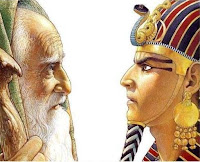
When Moses told Pharaoh that Yahweh said to let his people go, Pharaoh replied, “Who is Yahweh that I should obey his voice? I don’t know Yahweh, and moreover, I will not let Israel go” (Ex 5:2). Even though Pharoah audibly heard the name, he did not know Yahweh. In a sense, Israel did not know yet either. The question, “He is what?” hung in the air.
When God spoke, he gave this recurring refrain “…and you shall know that I am Yahweh…” (Ex 6:7; 7:5,17; 8:10,22; 9:16; 10:2; 14:4,18; 16:12; 29:46; 31:13). Very soon, the question “He is what?” would be answered not through a set of theological propositions, but through God’s actions. God will demonstrate that he is a God that does not forget his covenant with their ancestor, Abraham, and will therefore deliver his people from bondage by striking mighty Pharaoh and all of Egypt.
The answer to the question, “He is what?” is answered through God’s redemptive actions which leads them through the wilderness to Mount Sinai. At Mount Sinai, God bound himself by a covenant to Israel. This reminds us that a person only gives his name to another because they will be enacting some sort of relationship. This is exactly what God does at the base of Mount Sinai. This is why he begins his covenant not with the Ten Commandments, but with the words, “I am Yahweh…” (Ex 20:2).
In the wilderness, God goes on to demonstrate who he is not through passing down theological formulas, but through his actions. This is simply the way it is in a relationship. We know our children and our spouse not simply because we know their names or a list of propositions about them. We know them through their actions. It is the same with God. His name is attached to the accounts of his redemptive actions on behalf of his people.
His name, “He is,” is not a stand-alone thought. His name is attached to his actions. The accounts and stories of the Bible are what answer the question, “He is what?” He is the living God. He is the God who provides. He is the God who sees. He is the God who hears. He is our redeemer. There are biblical stories and accounts for each of these statements. This is why it is important to remember and reflect on the stories of God in the whole Bible
Thursday, February 17, 2022
God's Love as Phileia
Titus 3:4-5 says, “But when the goodness and loving kindness of God our Savior appeared, he saved us,…” loving kindness is philanthropia, which literally means love for mankind and is the origin of our English word philanthropy. God’s love for man, which led to the cross is the ultimate philanthropy. There is no love for mankind like the love of God.
Romans 12:10 says, “Love to one another with brotherly affection. Outdo one another in showing honor.” Love here is philostorge, a combination of phileia (love/affection) and storge (family love). Brotherly affection is philadelphia, which means brotherly love. We are called to have familial affection for one another. That means that we must get along and like each other. This may seem impossible, but I can remember siblings who could not stand each other. The parents’ solution was to make them hold hands for several days and do everything together. It was not acceptable that they had disdain for each other. If that is the way it is with a physical family, how much more so would this be for the family of God? After all we are blood, but it is blood that goes for beyond this life. We are related by the blood of the Son of God who shed it in order to adopt us into God’s family.
Romans 12:13 says to “Contribute to the needs of the saints and seek to show hospitality.” Hospitality is philoxenia, which literally means, “strangerly love.” Not only are we to show brotherly love to our brethren, we are also to show strangerly love to the stranger. This implies a level of kindness and compassion that we see demonstrated in Jesus as he welcomed people from all walks of life, whether they tax collectors or pharisees.
Several passages tell us to greet each other with a holy kiss (Rom 16:16; 2 Cor 13:12; 1 Thess 5:26; 1 Pet 5:14). Kiss is philema, which is in the same class of words as phileia. As I reflect on this, it occurs to me that this expression seems to be much more intimate than our typical handshake. But even though this was a typical cultural expression for that time, the word, “holy” indicates that this is not just the typical kiss of greeting, but is special. Our relationship with each other in the family of God is different than associations we have with those outside. We greet each other with holy tokens of affection because we have been sanctified and adopted by God to be his family.
This has caused me to reflect on the nature of love. I remember a time when I used to think, “I have to love you, but that doesn’t mean I have to like you!” This came from the mistaken idea that love, specifically agape, had nothing to do with emotion or liking someone. I now see the ludicrous nature of trying to love without any kind of affection. The instructions to love in the passages above seem to indicate just the opposite. We are not called to like someone, but are called to love, which is much deeper than like.
Sunday, February 13, 2022
Those Who Challenged God
Our God is an all-powerful, holy, holy, holy God. It is not unusual for someone who encounters God in his holy splendor to prostrate himself flat on his or her face in fearful reverence. The call of Isaiah in Isaiah 6 is a classic example of this. The covenant people of God at the base of mount Sinai had a similar reaction. The holy presence of God covered the top of Mount Sinai with smoke, thunder and lightning along with his great voice. They were so fearful that they wanted to hear the voice of the Lord no more, and asked Moses to be their mediator so they would not have to hear God's voice directly.
Knowing this about our God, many believers
would not want to question or challenge God. Few would even dream of implying
God might do something too extreme or unwarranted. Yet that is just what Job
does in the book of Job. However, Job is not the only one in scripture who is
so bold and daring. Maybe it's understandable in Job's case. After all, from a
human standpoint he doesn't have much to lose. If God were to smite him, he
would die and that would be the end of his suffering. But that is not what Job
wants. He wants vindication, but that's another study.
Is it ever okay to challenge God's decisions
and actions? Leaving aside the whether there could ever be an appropriate time
to do this, there are some illuminating examples of prominent servants of God
who boldly challenged the Almighty.
The first example comes from Genesis 18:22-33.
God revealed to Abraham that he would destroy Sodom and Gomorrah because of
their wickedness. The Hebrew of the passage emphasizes the greatness of their
sin in verse 20. Their sin is great "to the extreme" or to put it in
contemporary terms, "to the max."
He refers to the great outcry from Sodom and Gomorrah, which suggest a
pattern of grave injustice and cruel wickedness. The story that follows about the treatment of
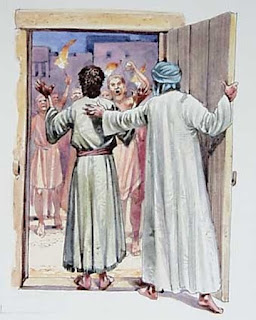
Lot’s guests shows the sheer depth of the depravity of the people there. Even
after being blinded, the text says that they were still groping to find Lot’s
door in order to rape his guests.
God had every right to destroy these cities,
and it is likely that anyone who knew anything about these cities would agree.
Then Abraham did the unthinkable. It wasn’t that Abraham tried to change God’s
mind. It wasn’t even that he tried to
bargain with God to spare the city for a handful of righteous people if they
are found in the city. Rather, it was his
bold question which could implicate God - "Far be it from you to do
such a thing, to slay the righteous with the wicked, so that the righteous and
the wicked are treated alike. Far be it from you! Shall not the judge of all
the earth deal justly?" (Gen 18:25). What was Abraham saying? Why would he ask such a thing? Did he really believe God might do a grave
injustice by slaying the innocent along with the wicked? Abraham knew he was
going out on a limb, so he pled with God not to get angry as he tried to save
the city for the sake of the righteous in it.
In the end, Abraham could not save the city, but as someone once put it,
"Abraham has saved God." In other words, if there was any doubt about
the justice of the destruction of Sodom and Gomorrah, the encounter between
Abraham and God and subsequent salvation of Lot and his family has removed all
doubt as to God's justice in destroying every man and woman in the city.
Another case in Moses. When God made a covenant with the newly
formed nation of Israel at Mount Sinai in Exodus 19. Israel responded with,
"All that the Lord has spoken we will do" (Ex 19:8). But just over a month later, they built an
idol and had a feast to the Lord. In response, "9 The Lord said to Moses, “I have seen this people, and behold, they are an
obstinate people. 10 Now then let Me alone, that My
anger may burn against them and that I may destroy them; and I will make
of you a great nation.” (Ex 32:9-10). There is no
doubt that the people are guilty. God redeemed them out of Egyptian bondage to
be his own people, and they have already rebelled. There is no doubt that God
would be justified when he carries out his intent to destroy these people.
What is curious is God’s words to Moses, “Let
me alone so that…” What is that
supposed to mean? Can Moses really stop
God from unleashing his wrath? In saying
this, God practically invited Moses to intervene. Just as God revealed to Abraham
what he was going to do to Sodom and Gomorrah, thereby allowing Abraham to
respond, God appears to do the same with Moses.
Moses responded to try and save Israel.
However, unlike Abraham, Moses cannot appeal to God’s justice to try and
save them. There was no doubt that they
had sinned and dishonored God even though they could look up and see the
presence of God that had enveloped the top of Mount Sinai. God would have been justified in destroying
Israel and starting over again with Moses and make of him a great nation. This would also been in keeping with the
promise God made to Abraham, since Moses was of the seed of Abraham. Instead, Moses responded with, “O Lord, why does Your anger burn against Your people whom You have brought out
from the land of Egypt with great power and with a mighty hand? 12 Why should the
Egyptians speak, saying, ‘With evil intent He brought them out to
kill them in the mountains and to destroy them from the face of the earth’?
Turn from Your burning anger and change Your mind about doing harm to
Your people. 13 Remember Abraham,
Isaac, and Israel, Your servants to whom You swore by Yourself, and said
to them, ‘I will multiply your descendants as the stars of the
heavens, and all this land of which I have spoken I will give to your descendants,
and they shall inherit it forever.” (Ex 32:11-13)
God had called them "this" people
when he wanted to destroy them, but Moses continues to call them "your"
people. Moses appeals to what the
Egyptians might say if God destroyed them in the wilderness, and the promise God
made to Abraham to multiply his descendants and reminded God that this is “your”
people. Moses simply asks God to relent
and change his mind, and the text goes on to say, “So the Lord changed His mind about the harm which He
said He would do to His people” (Ex 32:14).
Unlike Abraham,
Moses was able to get God to relent, which was because of the covenant that God
had made with theses people.
Another example comes from Amos 7:1-7.
7 Thus the
Lord God showed
me, and behold, He was forming a locust-swarm when the spring crop
began to sprout. And behold, the spring crop was after the king’s
mowing. 2 And it came about, when it
had finished eating the vegetation of the land, that I said, “Lord God, please
pardon!
How can Jacob stand, For he
is small?” 3 The Lord changed His mind about this. “It
shall not be,” said the Lord. 4 Thus
the Lord God showed me, and behold, the Lord God was calling to contend with them by fire, and
it consumed the great deep and began to consume the farm land. 5 Then
I said, “Lord God, please stop!
How can Jacob stand, for he is small?” 6 The Lord changed
His mind about this. “This too shall not be,”
said the Lord God.”
Twice, God announces judgement on Israel in two
visions. Twice, Amos pleads with God, and twice God changed his mind.
The picture Amos paints of the nation and her
sins in the previous six chapters of Amos makes it clear that God is justified
in unleashing his wrath against Israel. God had caused the nation to become
prosperous. However, many were getting rich at the expense of the poor, so God
decides to withdraw his blessing and unleash his judgement. These include judges taking bribes and
perverting justice, exploitation of the poor and needy, idolatry, incest, violence
against the helpless, etc. There was do
doubt that Israel deserved the justice God planned to bring. However, when God showed Amos what he would
going to do, Amos managed to swerve the nature of God’s judgment.
There are other examples of men challenging God
and/or changing God’s mind However, there is something unique about the
examples above. What is amazing is that God intentionally involves men in his
decisions. Moses could have consented
and said, "I'm just your slave, I can't stop you. Besides, you're the
boss, do what you see is best". Instead, Moses boldly tells God it would
be better if God were to spare Israel so that Egypt would not think that God
brought Israel out to the wilderness with the evil intention of destroying them.
So Moses boldly gives God what he perceives to be a better option, and God
takes it! The same could be said of Abraham and Amos.
This demonstrates something about God’s character. God’s righteous anger is aroused by wickedness
and rebellion. However, his compassions
are also kindled by the pleads for mercy.
Here is what God said about himself to Moses when he revealed himself to
him in the cleft of the rock:
“6 Then the Lord passed by in front of him and proclaimed, “The Lord, the Lord God, compassionate and
gracious, slow to anger, and abounding in lovingkindness and truth; 7 who keeps
lovingkindness for thousands, who forgives iniquity, transgression and sin; yet
He will by no means leave the guilty unpunished, visiting
the iniquity of fathers on the children and on the grandchildren to the third
and fourth generations.” (Ex 34:6-7)
This passage from the New American Standard translates the Hebrew word, “hesed”
as lovingkindness. The word, which has
no English equivalent, is sometimes rendered, steadfast love, unfailing love,
loyalty, or even kindness/mercy. An
acceptable translation would be, “covenant love.” This word refers to love by covenant. In other words, love that is a choice. I can’t
help but notice the contrast of God visiting the iniquities of the fathers to
the third and fourth generations, but covenant love to thousands.
This self revelation of God and his character became the basis of Moses
pleading to God for Israel once again.
After rebelling and making a short-lived plan to elect a new leader and return
to Egypt, “11 The Lord said
to Moses, “How long will this people spurn Me? And how long will they not
believe in Me, despite all the signs which I have performed in their midst? 12 I
will smite them with pestilence and dispossess them, and I will make
you into a nation greater and mightier than they” (Num 14:11-12).
Once again, God wanted to stary over again with Moses, Israel had a pattern of grumbling and rebellion
against God.
“13 But Moses said to the Lord, “Then the Egyptians will hear of
it, for by Your strength You brought up this people from their midst, 14 and
they will tell it to the inhabitants of this land. They have heard
that You, O Lord, are in the
midst of this people, for You, O Lord,
are seen eye to eye, while Your cloud stands over them; and You go before them
in a pillar of cloud by day and in a pillar of fire by night. 15 Now
if You slay this people as one man, then the nations who have heard of
Your fame will say, 16 ‘Because
the Lord could not bring
this people into the land which He promised them by oath, therefore He
slaughtered them in the wilderness.’ 17 But now, I
pray, let the power of the Lord be great, just as You have declared, 18 ‘The Lord is slow to anger and abundant
in lovingkindness, forgiving iniquity and transgression; but He will by no
means clear the guilty, visiting the iniquity of the fathers on the
children to the third and the fourth generations.’ 19 Pardon,
I pray, the iniquity of this people according to the greatness of Your
lovingkindness, just as You also have forgiven this people, from Egypt even
until now” (Numb 14:13-19).
Moses once again pled with God to forgive
Israel. This time, he repeats God’s own words
about the kind of God he is: “slow to anger and abundant in covenant love.” Based on this, he prayed that God pardon them
“according to the greatness of your covenant love.”
“So the Lord said,
“I have pardoned them according to your word” (Num 14:20).
It occurs to me that all of this demonstrates
that God is eager to forgive. Indeed,
the Psalmist wrote,
5 For You, Lord, are good, and ready to
forgive,
And abundant in lovingkindness to all who call upon You”
(Ps 86:5).
God is ready to forgive. He is eager to forgive. He is so eager that he has at times invited the
righteous to pray for and plead of behalf of his people. Based on the greatness of his unfailing love
and the pleading of someone to advocate for his people, God changes his mind
and relents.
I know there may be those who might claim this is
heresy because it attacks the doctrine of God’s sovereignty and the immutability
of God. However, instead of starting
with doctrinal statements and looking for scripture to support them, one should
simply read the scriptures and allow them to speak for themselves as to the
kind of God we serve. God does not reveal
himself in theological propositions, logical deductions, and doctrinal
formulas. To reduce God to a proposition does him injustice. God reveals
himself through his actions, which are preserved for us in scripture. The
Biblical authors do not make the attempt to minimize God to the lowest common
denominator. The closest thing you have to this are the statements made about
God in various Psalms in the Psalter and Psalms sprinkled throughout the rest
of the Old Testament. However, these are not mere abstractions, but are often
connected with a story. Even the law given at Sinai is inseparable from the
history connected to it. To separate law from the story leads to legalism. God
is our Father who has come to live among us, not an abstract theological
deduction.
God is holy, but he is not so sensitive that
his people cannot question him. God is much bigger than we are. He can take it.
As uncomfortable as this may be at
times, it can be considered a great act of faith and is often the time of the
greatest spiritual growth.

Tuesday, February 08, 2022
Bible Reading Reflection (Exodus 26): God's Covering
This helps to more appreciate our Lord’s atoning work through Christ. God came out of the holy of holies and into a human body. God came near, but covered himself this time in human flesh. He shared in our flesh and blood to provide a permanent solution for sin by offering up his own blood. He entered into the human experience so that he could sympathize with us in mercy and faithfulness. He has come near in such a way so that we can refer to him not only as our God, but also our Abba, our Papa, our Father.
Thank you for being faithful and not giving up on us. You have drawn near to us, may we draw near to you.
Thursday, February 03, 2022
Bible Reading Reflection (Exodus 10-12): Hardened Heart and God's Name
Thursday, January 20, 2022
Bible Reading Reflection (Gen 19-21)
So many questions about the bizarre incident with Lot and the men of Sodom. Did Lot know that these men were from God? Does that explain his actions in regard to his daughters? And after so forcefully defending them against the perpetrators who tried to break down his door, why did Lot practically have to be pulled by the hand out of the city even after their warning that it was going to be destroyed and he along with it if he did not leave? After the men of the city were struck blind, how could they be so depraved as to wear themselves out still looking for Lot's door? Can depravity be so deep that being struck by divine judgment such as blindness has no effect? Knowing the character of this place, why did Lot's wife look back? Why was she turned into a pillar of salt? How was her look at the destruction different from the look of Abraham who saw the destruction in the morning?