Showing posts with label hope. Show all posts

Friday, January 21, 2022

Bible Reading Reflection (Gen 27-29): Where is My Life Focused?

It was not uncommon for God’s chosen family to act less than honorably.  The recent daily Bible readings covered Isaac and their two sons, Jacob and Esau.  We usually refer to them as Jacob and Esau, but I wonder if they were originally referred to as Esau and Jacob because Esau was older? 

I have contemplated the events that led to the rise of Jacob over his brother with puzzlement.  Why did God bless Jacob who took what should have belonged to Esau?  Why did their mother conspire to steal what belonged to one son to give it to the other?  What kind of mother does that?  Why did the chosen family have so much drama from generation to generation?  It occurs to me that none of these things are unusual among human beings.  Family drama seems to always be part the story of many families.

Several details stand out in these events.  Before the brothers were even born, they were struggling with each other.  Yahweh told Rebekah that there were two nations in her which will be divided, one would be stronger, and the older would serve the younger.  Did she tell Isaac?  Did he know?  The text does not say.

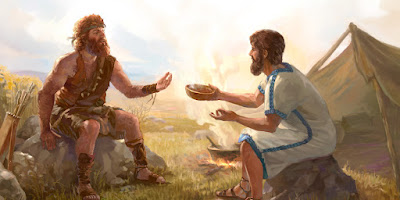
Esau did not seem to care about his birthright as the older son.  He sold it away to Jacob for a single pot of stew.  Even though he despised his birthright, he would later come to regret it.  This seems to paint a picture of Esau as an impulsive person who is ruled by his passions rather than a sense of destiny from God. 

In addition to this, Esau married before Jacob.  He married two Hittite women and they made life bitter for Isaac and Rebekah.  The text does not mention how, but I wonder if any of it does not stem from the fact that they were of a different ethnic and religious background. 

When it came time for Isaac to give the final blessing to his posterity, he was going to give it to Esau, and not Isaac.  All of these details - from the prophecy that Yahweh told her about the older serving the younger, to Esau selling his birthright, and his marriage to Hittite women rather than those of his own clan, may have been the motivation behind Rebekah's conspiracy to make sure the blessing went to Jacob, the one whom God had chosen.

There was one final thing that Rebekah wanted to see happen.  She did not want Jacob to marry Hittite women as Esau did.  She went to far as to tell Isaac that her life would be over if Jacob married a Hittite woman.  So Isaac sent Jacob to Rebekah’s brother, Laban, in Haran to find a wife from his own clan and charged him not to marry any of the Canaanite women.  Before he went, Isaac blessed him, saying, “May God Almighty bless you and make you fruitful and multiply you that you may become a company of peoples.  May he give you the blessing of Abraham to you and your offspring with you, that you may take possession of the land of your sojournings that Gave gave to Abraham.”  Giving him the blessing of Abraham shows a clear sense of the big picture from God that did not seem to be important to Esau at all.

What a contrast!  Esau did not care about God’s big picture, and Jacob spent his entire life grabbing at the heels of what God had already determined would be his!  What lessons should we draw from this?  I don’t often hear people draw lessons from Jacob, who acted less than honorably.  I don’t often hear lesson from Esau either.  However, the Bible draws lessons from both of them. I am reminded of two passages from the book of Hebrews that draw lessons from both Jacob and Esau.

In Hebrews 11, which gives numerous examples of faith, it says, “By faith Abraham obeyed when he was called to go out to a place that he was to receive as an inheritance. And he went out, not knowing where he was going.  By faith he went to live in the land of promise, as in a foreign land, living in tents with Isaac and Jacob, heirs with him of the same promise.  For he was looking forward to the city that has foundations, whose designer and builder is God“ (Heb 11:8-10).

Jacob, along with his father, Isaac, and his grandfather, Abraham, is an example of a life of faith.  This shows that faith is tied to hope, which is always looking forward to the distant future.  The takeaway is not Jacobs heel-grabbing, deceitful designs on trying to get what God had already determined would be his.  The takeaway is that he lived in life in the shadow of the destiny that had God had planned. 

In Hebrews 12, the text gives an exhortation using Esau as a negative example.  It says, “Therefore lift your drooping hands and strengthen your weak knees, and make straight paths for your feet, so that what is lame may not be put out of joint but rather be healed.  Strive for peace with everyone, and for the holiness without which no one will see the Lord.  See to it that no one fails to obtain the grace of God; that no “root of bitterness” springs up and causes trouble, and by it many become defiled; that no one is sexually immoral or unholy like Esau, who sold his birthright for a single meal.  For you know that afterward, when he desired to inherit the blessing, he was rejected, for he found no chance to repent, though he sought it with tears” (Heb 12:12-17).

The text describes Esau as one who let a poison root grow in his life that caused trouble and defilement.  It refers to him as sexually immoral and unholy.  He evidently did not regard himself as holy to the Lord, as can be seen by all his actions.  He did not feel any obligation to Yahweh’s plan for the future.

This message, be like Jacob and not Esau, is focused one thing:  Hope.  Faith is the assurance of things hoped for, according to the opening lines of Hebrews 11.  The examples in Hebrews 11 of faith is not a list of people who had no flaws and shortcomings, but a list of people who lived their life in commitment to the shadow of the future which God had promised.

Everyone has hopes and dreams, but if our hope is in this life only, then we are of all people most to be pitied.  The question to ask myself is this:  Do I live my life in the shadow of hope that is rooted in God’s plan?  Do I order my life according to the Christian hope?  How does this affect my overall plans?  How does this affect my marriage?  How does this affect my friendships?  How does this affect my vocation?

Friday, November 01, 2019

Government Can't Save You

Some people place all their hopes in government, political causes, and elections.  Someone once said that for some people, it seems as though politics is a religion.  This is nothing new.  I am reminded of how ancient Rome was a religion, complete with temples to worship Caesar.  At one point, even the calendar was reworked to begin with the birth of Caesar.   

The Priene Calendar Inscription gives the rationale for the resetting of the calendar to begin with the birth of Augustus, since it was he who ended the previous era and began a new one.  This inscription, dated to 9 BC, says,

"Since the Providence which has ordered all things and is deeply interested in our life has set in most perfect order by giving us Augustus, whom she filled with virtue [divine power] that he might benefit humanity, sending him as a savior, both for us and for our descendants, that he might end war and arrange all things, and since the Caesar through his appearance has exceeded the hopes of all former gospels, surpassing not only the benefactors who came before him, but also leaving no hope that anyone in the future would surpass him, and since for the world the birthday of the god was the beginning of the gospel that came by reason of him . . . "

According to this declaration, Augustus was sent as a "savior" to "end war" and "arrange all things."  His birth is called the "beginning of the gospel."  He has surpassed all other benefactors before and after him, according to this inscription.

The phrase, "beginning of the Gospel" reminds me of what was written a few decades later by Mark, in his Gospel, who started with, "The beginning of the Gospel of Jesus Christ, Son of God…"  It is illuminating to contrast the "Gospel of Caesar Augustus" to the "Gospel of Jesus Christ."  What kind of "savior" was Caesar Augustus?  What kind of savior is Jesus Christ?

Whatever Caesar Augustus accomplished was short lived.  In 14 AD, death claimed him whom they declared as their "savior" and their "God."  He was no God and therefore died just like any other man.  To this day, he is still dead.  His kingdom is also dead.  His accomplishments rest on the ash heaps of history. The word, "Caesar" today makes one think of a salad rather than a God. 

However, the name of Jesus is still the name of above all names.  His accomplishments endure to this day and are still increasing.   Jesus also died.  However, he rose from the grave.  The Christian Gospel is not just that Jesus, who is God, came into the world, but that he died and rose from the dead.  His death was redemptive.  His resurrection is hope.  He also established his Kingdom which continues to thrive until this day.  His Kingdom will last from this world and into eternity.  He brings peace not through political stability, but through wiping out our sins, redeeming us to God, and reforming our heart. 

While Caesar's laws might regulate behavior depending on the presence of law enforcement, the Gospel of Christ is what transforms the heart and mind, something Caesar is powerless to do.  All attempts by the various kinds of Caesars of the world to establish a peaceful Utopia have failed miserably.  If history teaches us anything, then it is likely that our own country will one day lie in ruins as Rome does.  Those who put all of their hopes in the Caesars of today will wind up empty. 

I remember seeing the picture of a president on the front page of a magazine at his reelection.  The title was "Second Coming."  That title spoke so much of how there were those placing their hopes in this political leader.  The only "second coming" that will ultimately save us is the second coming of Christ.  Jesus is our savior, our King, and our Lord.  He brings true peace now in his Kingdom, which will continue once for all in the New Jerusalem.  Jesus saves!


Tuesday, April 17, 2018

The God of Glory Thunders


As I sit here and observe the heavy rain and the high winds, my heart began to race a little.  I sat inside the safety of this building, but if this were a tornado, not even this building may be safe.  I sat and listened in case the sirens went off, warning of an impending tornado.  I learned the following day that this storm had done it's share of damage to buildings, signs, and even knocked out the power in certain areas.

My mind went back to other Nebraska storms I had seen.  A couple of years ago, I saw a tornado dipping down from the sky to the land.  Fortunately, it was at least three or for miles away and was not headed in my direction.  At another time, I remember a tornado warning in my area.  I was at a friends house who lived right on the river.  I was not too worried because tornadoes do not typically hit the river.  But then a flash flood warning came over the radio.  I decided the odds were better facing a possible tornado than a flash flood, so I headed home.  I can remember the two feet of water rushing down the street in the middle of town.  Fortunately, our home was on higher ground and I made it safely.  The following day, I went out to see the aftermath.  That water had actually torn up the asphalt all over the lower parts of town. 

I remember the aftermath of tornadoes in the city when I was growing up.  I was in elementary school back then, but those scenes of houses lifted right off their foundations are still vivid in my mind.

Storms can make person feel small and insignificant.  I still remember storms that came of the gulf when I was stationed there.  The amount of rain and the high winds made me feel like I was irrelevant to everything happening around me.  Fortunately, none of those storms during my time there developed into hurricanes.  I have seen photos of the devastation that a storm that starts at sea can make when it hits land.

I am reminded of the 29th Psalm: 

Ascribe to the LORD, O sons of the mighty,
Ascribe to the LORD glory and strength.
Ascribe to the LORD the glory due to His name;
Worship the LORD in holy array.

The voice of the LORD is upon the waters;
The God of glory thunders,
The LORD is over many waters.
The voice of the LORD is powerful,
The voice of the LORD is majestic.
The voice of the LORD breaks the cedars;
Yes, the LORD breaks in pieces the cedars of Lebanon.

He makes Lebanon skip like a calf,
And Sirion like a young wild ox.
The voice of the LORD hews out flames of fire.
The voice of the LORD shakes the wilderness;
The LORD shakes the wilderness of Kadesh.
The voice of the LORD makes the deer to calve
And strips the forests bare;
And in His temple everything says, “Glory!”

The LORD sat as King at the flood;
Yes, the LORD sits as King forever.
The LORD will give strength to His people;
The LORD will bless His people with peace.

This passage poetically reminds us that Yahweh is the all powerful Lord of the storm.  The army of the Lord is the wind, rain, flood, and lightning.  He shakes the ground when he thunders.

Here is what I find encouraging.  He does not reach down to destroy us, but to give life.  His voice causes his creation to skip and dance with life.  His voice causes his creation to give birth.  His voice gives his people strength and peace. 

Oh what a curious mix of trembling, fear, hope, and joy!  Truly he, and he alone, is the one that brings down to the grave and makes alive.  In the midst of the storm, I am reminded that God sits as king above it all.  He displays his power, which is not against me, but for me.  As my heart beats faster when I hear the wind howling and the hail beating against the roof, I am reminded that I am always safe in the arms of Jesus.  When might bring fear actually brings a sense of peace and calm.

I am reminded of Jesus, who was fast asleep in the middle of the storm.  His disciples were with him and had not yet grasped the full significance of who they were with.  Jesus, who tramples down the waves of the sea, who commands the wind with a single word, who is Lord of the storm, is our master and Lord.

The storm comes in many forms does it not?  Cancer may come and attempt to blow away my courage.  Sicknesses of various kinds may come threaten to topple my confidence.  Missed expectations in my walk with God may send the whirlwind against the walls of my faith.  Suffering may throw hailstones on the roof of my bravery. 

But then God reminds me that I am in the boat with Jesus, and there is nothing to fear.  The boat may seem like a scary place to be, but Jesus is not worried at all because he is Lord of the storm.  Jesus will lead me safely to the other side.  Even if the storm topples my tent, the tent was temporary anyway.  I am looking for a permanent home with the Lord that will never be destroyed.  Jesus will lead me safely to his eternal home where there will be no more sorrow, death, sickness, or pain. 

I am now reminded that our Lord will not lead us safely around the storm, but will lead us safely through the storm.

Here are some passages that are a good reminder of the various ways our Lord thunders from the Heavens.

Nehemiah 1:2-8

A jealous and avenging God is the LORD;
The LORD is avenging and wrathful.
The LORD takes vengeance on His adversaries,
And He reserves wrath for His enemies.

The LORD is slow to anger and great in power,
And the LORD will by no means leave the guilty unpunished.
In whirlwind and storm is His way,
And clouds are the dust beneath His feet.

He rebukes the sea and makes it dry;
He dries up all the rivers.
Bashan and Carmel wither;
The blossoms of Lebanon wither.

Mountains quake because of Him
And the hills dissolve;
Indeed the earth is upheaved by His presence,
The world and all the inhabitants in it.

Who can stand before His indignation?
Who can endure the burning of His anger?
His wrath is poured out like fire
And the rocks are broken up by Him.

The LORD is good,
A stronghold in the day of trouble,
And He knows those who take refuge in Him.

But with an overflowing flood
He will make a complete end of its site,
And will pursue His enemies into darkness.


Job 37:2-13

Listen closely to the thunder of His voice,
And the rumbling that goes out from His mouth.

Under the whole heaven He lets it loose,
And His lightning to the ends of the earth.

After it, a voice roars;
He thunders with His majestic voice,
And He does not restrain the lightnings when His voice is heard.

God thunders with His voice wondrously,
Doing great things which we cannot comprehend.

For to the snow He says, ‘Fall on the earth,’
And to the downpour and the rain, ‘Be strong.’

He seals the hand of every man,
That all men may know His work.

Then the beast goes into its lair
And remains in its den.

Out of the south comes the storm,
And out of the north the cold.

From the breath of God ice is made,
And the expanse of the waters is frozen.

Also with moisture He loads the thick cloud;
He disperses the cloud of His lightning.

It changes direction, turning around by His guidance,
That it may do whatever He commands it
On the face of the inhabited earth.

Whether for correction, or for His world,
Or for lovingkindness, He causes it to happen.


Psalm 107:23-32

Those who go down to the sea in ships,
Who do business on great waters;

They have seen the works of the LORD,
And His wonders in the deep.

For He spoke and raised up a stormy wind,
Which lifted up the waves of the sea.

They rose up to the heavens, they went down to the depths;
Their soul melted away in their misery.

They reeled and staggered like a drunken man,
And were at their wits’ end.

Then they cried to the LORD in their trouble,
And He brought them out of their distresses.

He caused the storm to be still,
So that the waves of the sea were hushed.

Then they were glad because they were quiet,
So He guided them to their desired haven.

Let them give thanks to the LORD for His lovingkindness,
And for His wonders to the sons of men!

Let them extol Him also in the congregation of the people,
And praise Him at the seat of the elders.


Tuesday, February 16, 2016

Reflection on Numbers 1-4: God's Ledger

As I began to read the book of Numbers, it became apparent from the first chapter why it is titled the book of "Numbers."  God instructed Moses to take a census of the people of Israel.  As a result, they counted all the men old enough to fight in the army from the various tribes and were laid out by camps around the tent of meeting.  Even the Levites, who were exempted from the battlefield, were numbered and arranged by their various priestly and levitical families and duties.  When all was said and done, everyone was numbered and accounted for.

The only reason the text gives as to the purpose of this accounting was to survey the number of people eligible to go out to battle.  It gives a number of the size of the fighting force in Israel.  But for whose benefit was this?  It doesn't seem that God would need to know the number of the righting men.  The number of men is irrelevant to God, as he demonstrated with people such as Gideon in the book of Judges.  One man and God is always a majority, regardless of the size of the opposing army.

Maybe this was to be a revelation to God's people and to the nations of how God had blessed his people and multiplied them.  God wanted his people to be fruitful, multiply, and fill the earth, according to Genesis 1-11.  In Exodus 19, God said that Israel would be a nation of priests.  As a priestly nation, they would have special access to God and be able to demonstrate God's character and goodness to the rest of the world.  In a far clearer way than the heavens that declare the glory of God, his priestly nation would declare his glory through their observance of God's Torah that God had given to them for their good.

Maybe it is to show that God's promise was not yet fully fulfilled.  God promised a childless Abraham a son and many descendants who would eventually have a land of their own.  In fact, God had promised Abraham in Genesis 32 that his descendants would be too great to be numbered.  God's people had been granted land in Numbers, but they were too few to be numberless.  There was still yet more to be fulfilled in God's promise.  God's blessing would overflow much more than this.

In Revelation 7, we see a highly symbolic picture of God's people on the earth from each tribe accounted for in a similar way to what we see in Numbers.  However, each tribe has a symbolic apocalyptic number of 12,000.  12, the symbolic number of God's people times 1,000, which is the number of completeness multiplied.  All of God's people in their completeness were accounted for.  This reminds me of the numbering of the tribes in the book of Numbers.  This was an accounting of the military force of God's people.  This is a reminder that God's people are in a state of spiritual conflict while on this earth.  After all, Jesus said that we are not of the world, and the world loves its own, but hated Christ and his followers.  But the text in Revelation also says that they were "sealed."  So not only was every single person accounted for in God's army, but God placed his seal on them to identify them as belonging to him and protect them. 

Then, the scene shifts up to Heaven, the throne room of God.  The text describes it as a "multitude which no one could count from every tribe, nation, people and tongues." This is a reminder of the promise that God made to Abraham that through his seed all the families of the earth would be blessed and that his descendants would be innumerable.  God's people, who are from every tribe, nation, and language, are safe in the hands of God.

This reminds me that God is faithful to his promises.  At times it may seem as though we are alone and God does not see us.  Sometimes we may forget about God's promises, but God never forgets.  God sees our struggle and hardships and nothing is ever beyond his notice.  Jesus makes this point when he talks about how God numbers even the hair on our head.  In Matthew 10:29-31, he said, "Are not two sparrows sold for a cent? And yet not one of them will fall to the ground apart from your Father.  But the very hairs of your head are all numbered.  So do not fear; you are more valuable than many sparrows."

Jesus, the good shepherd, has accounted for every single sheep.  All of us are on his heart, and none of us are beneath his notice.  We are much more than a number to him.  In John 10, I am reminded that Jesus said that he knows his sheep by name.  In his book of life, we are more than a number.  He has our names, which he knows intimately, written in his book of life.   In fact, it is even more intimate than this.  In Isaiah 49:15-16, God says, "Can a woman forget her nursing child And have no compassion on the son of her womb? Even these may forget, but I will not forget you.  Behold, I have inscribed you on the palms of My hands; Your walls are continually before Me."  God has us tattooed or etched on his hands.  We are much more than a number and much more than a name in a book to our God.  We are near to his heart like a baby is to his mother!

Lord, how loving, kind, and compassionate you are!  You are our Father, and you are our Mother.  You protect us and provide for us.  You love us and nurture us.  Thank you for reminding us of these things in your word so that we can grow in hope, and encouragement.  Help us to see ourselves and one another the way that you see us.  Help us to love as you love.  Help us to look to Jesus as our example of true love in action.  Thank you in his name, Amen!

Thursday, February 11, 2016

Reflection on Exodus 1-2: When You are Stuck in Chapter 2

Exodus 2:23 says that in the course of those many days, the king of Egypt died, and the sons of Israel sighed because of their bondage and cried out.

For years, I read quickly over Exodus chapter one and two.  Because so much time is compressed in those two chapters, I don't think I ever fully appreciated how difficult those chapters were.  Whether it is in the burning bush, the plagues or the pillar of fire in the wilderness, God is intensely present throughout the book of Exodus.  Well, he is intensely present throughout all of the book of Exodus except for chapters one and two.

I don't know how bad those "many days" were, but they were bad enough for an entire nation to groan and cry.  They probably saw no end in sight.  They probably could not envision better days ahead.  They were probably overcome with depression, grief, uncertainty, fear, and despair. 

Before jumping ahead to the burning bush, perhaps it would be good for me to consider chapter two.  There are times in life when we are in chapter two, and we can't just turn the page.  Chapter two seems to be the end.  We can't see anything better down the road. 

However, Exodus 2:24 says that God heard their groaning, remembered his covenant, and took notice.  We may not be able to turn the page, but God can.  He provides future chapters full of hope, a better future, redemption and deliverance.  He writes the conclusion when he will wipe all tears from our eyes and will destroy all death, pain, mourning, and sickness.  Then we will live in complete peace with him.