Showing posts with label bible. Show all posts

Tuesday, January 17, 2023

The Wise & Intelligent vs. Little Children

In Matthew 11:25-26, Jesus offered this prayer of thanksgiving. 

"…I thank you, Father, Lord of heaven and earth, that you have hidden these things from the wise and understanding and revealed them to little children; yes, Father, for such was your gracious will."

What a contrast between the “wise and understanding” verses “little children!”  Jesus had just finished condemning several Jewish cities for their refusal to accept his message and change.  The centers of education and wisdom did not accept Jesus and his message.  In contrast, Jesus pointed out that if the pagans had seen his mighty works, they would have repented long ago in sackcloth and ashes.

Wisdom can be a slippery thing if one does not approach it from a biblical standpoint.  In the Old Testament, Wisdom is “Chokmah,” and in the New Testament, it is “Sophia.”  Biblical teaching concerning these tells us that it is more than mere knowledge or skill.  It does not come merely from age, education, or merely experience.  It comes from response to God and the pursuit of the knowledge of God.

Earlier in the chapter, Jesus compared that present generation to children in the marketplace that call out to each other.

“But to what shall I compare this generation? It is like children sitting in the marketplaces and calling to their playmates, “‘We played the flute for you, and you did not dance; we sang a dirge, and you did not mourn.’” (Mt 11:16-17).

This paints a picture of children who wanted to call the shots with their own agenda.  They Jews who rejected Jesus were like children who wanted everyone else to play by their rules.  If they did not, like childish children, they would become upset of the others did not play by their own rules.  Jesus pointed at that this is exactly what happened when John the Baptist came preaching while fasting.  Since John did not play by their rules, they accused him of having a demon.  When Jesus came preaching while feasting, they accused him of being a glutton and drunkard who hung out with sinners.  In other words, neither John nor Jesus danced to their tune.  They refused to recognize the authority of John, and rejected the lordship of Jesus.

After this, Jesus pointed out, “Yet wisdom is justified by her deeds” (Mt 11:19).  Jesus didn’t say which specific deeds justified wisdom.  Perhaps it was the signs and miracles Jesus performed along with his preaching.  Perhaps it also included those who responded to Jesus with faithful obedience and repentance.  Whatever it was, the irony is that the “little children” who responded to Jesus surpassed the “wise and intelligent” through their simple obedience to Jesus.  

This is a reminder of how Jesus wrapped up the Sermon on the Mount:

“Everyone then who hears these words of mine and does them will be like a wise man who built his house on the rock. And the rain fell, and the floods came, and the winds blew and beat on that house, but it did not fall, because it had been founded on the rock. And everyone who hears these words of mine and does not do them will be like a foolish man who built his house on the sand. And the rain fell, and the floods came, and the winds blew and beat against that house, and it fell, and great was the fall of it” (Mt 7:24-27).

The wise man is the faithful and obedient man.  His “house” is solid and sure.  This is the image Proverbs gives when it says, 

“Wisdom has built her house;
    she has hewn her seven pillars”  (Prov 9:1).

The pillars in Wisdom’s house indicate strength and support.  It means a life built with sound building practices.  Interestingly, Wisdom (chokmah) in Hebrew is not singular put plural (chokmoth) in this verse.  This is reminiscent of the most common designation for God in the Old Testament, which is the plural word for God, Elohim, and not the singular word, El, or Eloah.  In Genesis 1, God (Elohim) created the Heavens and the Earth.  In Hebrew, it is not “they created” but “he created.”  The singular verbs indicate ONE God, but stated by a plural designation for God.  This grammatical construction is not uncommon in the Ancient Near East when it comes to an exalted or majestic individual. An exalted or majestic individual would use plural words for himself. No one is more majestic and exalted than God, therefore God, (Elohim).  In Proverbs 9, wisdom, stated as a plural, is also depicted as majestic.  This shows her connection and close association with God.  In fact, in Proverbs 8, she declares that she is the architect of the created order.  Whether it is the physical, ethical, moral, or social order by which all of life was designed, it was designed by the wisdom of God.

This majestic and divine wisdom may seem foolish to those who try to attain wisdom apart from God.  However, the Bible clearly says that wisdom apart from God is foolishness.  But wisdom apart from God is what is foolishness. 

“For although they knew God, they did not honor him as God or give thanks to him, but they became futile in their thinking, and their foolish hearts were darkened. Claiming to be wise, they became fools, and exchanged the glory of the immortal God for images resembling mortal man and birds and animals and creeping things” (Rom 1:21-23).

Those who throw of the shackles of religion may think they are more wise, enlightened, and intelligent.  Instead of looking to the creator, they begin to look to the creation.  It becomes all about gaining wisdom from the sciences instead of biblical theology and its philosophy.  This may seem more enlightened and intelligent than religion.  However, the Bible says they become fools when they try to become enlightened without God.

God’s wisdom will seem like foolishness to those outside of Christ.  This should never intimidate nor embarrass us.  It should not cause us to be drawn to the wisdom of the world.  As a reminder of the contrast between the wisdom of the world and the wisdom of God, 1 Corinthians says,

“For the word of the cross is folly to those who are perishing, but to us who are being saved it is the power of God. For it is written,
“I will destroy the wisdom of the wise, and the discernment of the discerning I will thwart.”
Where is the one who is wise? Where is the scribe? Where is the debater of this age? Has not God made foolish the wisdom of the world? For since, in the wisdom of God, the world did not know God through wisdom, it pleased God through the folly of what we preach to save those who believe. For Jews demand signs and Greeks seek wisdom, but we preach Christ crucified, a stumbling block to Jews and folly to Gentiles, but to those who are called, both Jews and Greeks, Christ the power of God and the wisdom of God. For the foolishness of God is wiser than men, and the weakness of God is stronger than men” (1 Cor 1:18-25).

The “wisdom of the wise” in this passage is the same sort of wisdom Jesus spoke of when he said that God hid these things from the “wise and understanding” but revealed them to little children.  The wisdom that God will destroy is godless wisdom.  This has already demonstrated itself in recent history.  Every experiment and attempt to deal with the human condition apart from God has not only failed fantastically, but has backfired and created worse conditions.  

One example of this is Marxism with its different forms throughout the 20th century.  Simply trying to eliminate religion does not make sin go away, but has a tendency to amplify it by removing the only way to deal with it, which is through the cross.  Simply trying to change the system without changing the root of the problem leads to greater and greater tyranny and wickedness. God, the creator, has identified the root of the problem, which is sin.  This is why salvation cannot come through simply changing the system, but has to come through a change in the human heart through the cross.  Only Jesus can deal with our sin.  Truly, the foolishness of God is wiser than the wisdom of men.

The questions in this passage, “Where is the wise man, the scribe, the debater of this age?” could be expanded in our time to, “Where is the philosopher, professor, politician, news anchor, celebrity?”  Just as ancient people looked to the sage, scribe, and debater as repositories of wisdom, people today look to those such as politicians, professors, celebrities, etc. as repositories of wisdom.  However, wisdom comes from the pursuit of God’s wisdom in reverence to him.

The rest of 1 Corinthians lays out what it should look like to deal with various challenges according to the wisdom of God and not according to the wisdom of the world.  The wisdom of the world says to be tolerant and accepting without calling it sin.  Chapter 5 says that we must be pure.  The wisdom of the world says that if you can’t get satisfaction, go to court.  Chapter 6 says that with our brethren, we must work it in the church, and drop it if we can’t.  The wisdom of the world says to get divorced if you are not happy with your spouse.  Chapter 7 says to stay married to your believing spouse.  The wisdom of the world says to insist on your rights.  Chapter 8 says to be willing to give up your rights for the sake of the faith of your brethren.  And the list goes on.  The wisdom of God is different than the wisdom of the world.

All of this is a reminder that wisdom does not automatically come with formal education, status, or even with age.  I used to associate gray hair with wisdom.  However, the Bible says this:

"The beginning of wisdom is this: Get wisdom,
    and whatever you get, get insight.
Prize her highly, and she will exalt you;
    she will honor you if you embrace her" (Prov 4:7-8).

I sometimes ask my classes, “What is the beginning of wisdom?”  Most of the time, the answer is, “the fear of the Lord,” which is true according to Proverbs 9:10.  However, this passage says that the beginning of wisdom is this – GET WISDOM!  This is a reminder that wisdom does not usually fall in your lap.  One must pursue wisdom.  It must be searched out.  It must be pursued.  The first nine chapters tells us that Wisdom is available if we pursue her diligently.  Here is an example:  

” …making your ear attentive to wisdom
    and inclining your heart to understanding;
yes, if you call out for insight
    and raise your voice for understanding,
if you seek it like silver
    and search for it as for hidden treasures,
then you will understand the fear of the LORD” (Prov 2:2-5).

The image of wisdom being hidden treasure evokes images of digging and mining for it.  It takes planning, dedication, and effort.  Wisdom does not simply come with age.  Many people probably know aged people who are very unwise and young people who are very wise.  This demonstrates that wisdom does not simply fall in one’s lap through experience.  It may take a struggle to gain it.  Job is an example of this.  Job  struggled valiantly to understand and lamented that it seemed that wisdom was buried too deep for anyone to find it.

1“Surely there is a mine for silver,
    and a place for gold that they refine.
2 Iron is taken out of the earth,
    and copper is smelted from the ore. …

12 “But where shall wisdom be found?
    And where is the place of understanding?
13 Man does not know its worth,
    and it is not found in the land of the living. …

20 “From where, then, does wisdom come?
    And where is the place of understanding?
21 It is hidden from the eyes of all living
    and concealed from the birds of the air.
22 Abaddon and Death say,
    ‘We have heard a rumor of it with our ears.’ (Job 28).

For Job, it took struggle and agony, but Job’s pursuit of God did eventually result in a new insight in wisdom from God.  He finally declared,

 “I had heard of you by the hearing of the ear,
    but now my eye sees you” (Job 42:5).

All of this should remind us that when we “overhear” Jesus’ prayer of thanksgiving in Matthew 11:25-26, it should encourage us to be confident in God’s wisdom.  It should assure us that he has truly given us everything we need for life and godliness.  It should move us to pursue God’s wisdom even if it seems out of reach at the moment.  It should strengthen our passion for the wisdom of God even as the wisdom of the world ridicules it.  

”...I thank you, Father, Lord of heaven and earth, that you have hidden these things from the wise and understanding and revealed them to little children; yes, Father, for such was your gracious will.”




Thursday, March 24, 2022

Reflections about Studying, Reading, and Meditating on God's Word


Sometimes I really dive into the text in my study.  I am reminded, though, of something I heard from a very wise and spiritual tuned person.  He said that one of the challenges for someone that has training in the biblical languages, exegesis, and theology, is engaging in what could be called "simply reading" the text.  


When I am trained to be able to study, analyze, and dissect the text, it is not unusual for me to be the one "in control" of the process.  The scriptures can easily become an object of study.  I believe it was Søren Kierkegaard that observed how scholars used the tools of scholarship to keep the scriptures at bay.  In other words, scholars used scholarship to avoid doing what the scriptures instructed.  The scriptures became an academic exercise, an artifact to be studied.  On the other hand, what can be called "simply reading," takes all of this and turns it on its head.  Rather than me approaching the text with my scalpel in order to dissect it, I get out of the driver's seat and let the scriptures take its scalpel to me.  Rather than me analyzing and dissecting the scriptures, the scriptures analyze and dissect me.  After all, the word of God is living and active and sharper than any two edged sword.  It dissects the thoughts and intentions of my heart.  This can be a challenge to someone with theological and scholarly training.  My first inclination is to grab my Greek or Hebrew text, my lexicons, word studies, historical studies, etc. 
 
It occurs to me that this is not a temptation just for those with scholarly training, but for anyone who engages in Bible "Study."  I look back on my own history and remember that even before I had theological training, I often did the same thing.  It can happen in Bible Classes, study groups, or in individual study.  This is a pitfall for everyone who approaches the Bible.  It seems that the only way to avoid this pitfall is to recognize the word of God as living and active.  It is not like other words because it is the word of God.  It is breathed out by the breath of God, which gives life.  When I read the words of scripture, I am reading something in a completely unique category.  This means that whether I am just "reading" or "studying," I need to begin with prayer.  I need to ask questions such as, "What is God communicating to me?"  or  "What does this teach me about God?"  I need to conclude with prayer and respond to the scriptures, which includes thanksgiving, praise, or repentance.  I need to recognize that God's word is the major tool that God uses on me, whether I think of it as the pure milk of the word that makes me grow, or the sword of the Spirit that helps me to overcome the schemes of the evil one, or something sharper than a two-edged sword, like a spiritual scalpel for my heart, mind, and soul.  

Thank you Lord for the incalculable blessing of your word!  My I meditate on it day and night and be as a tree that has been transplanted by living water, bearing fruit for your glory!

Thursday, January 20, 2022

Bible Reading Reflection (Gen 19-21)

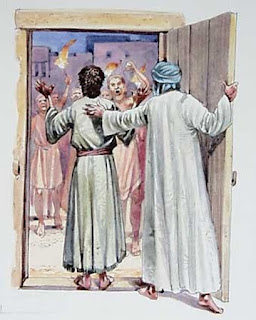
So many questions about the bizarre  incident with Lot and the men of Sodom.  Did Lot know that these men were from God? Does that explain his actions in regard to his daughters? And after so forcefully defending them against the perpetrators who tried to break down his door, why did Lot practically have to be pulled by the hand out of the city even after their warning that it was going to be destroyed and he along with it if he did not leave?  After the men of the city were struck blind, how could they be so depraved as to wear themselves out still looking for Lot's door?  Can depravity be so deep that being struck by divine judgment such as blindness has no effect? Knowing the character of this place, why did Lot's wife look back?   Why was she turned into a pillar of salt?  How was her look at the destruction different from the look of Abraham who saw the destruction in the morning? 

Maybe I am asking the wrong questions. Perhaps the controlling focus of all of this is simply that God is fulfilling his promise to bless Abraham and to bless those who bless Abraham while cursing those who lightly esteem him.  This would also help make sense of the whole Abimelech affair as well.  Abraham seems to be making a habit of saying that Sarah is his sister so that people will not kill him in order to steal his coveted wife.  God told him not to fear, but God does not criticize Abraham, but apparently strikes Abimelech and all who are his was some sort of pestilence that keeps them from having children, at least until he returned Sarah back to Abraham.  Perhaps this is more of the same focus, which is God blessing Abraham just as he had promised, and cursing those who lightly esteem him.

Perhaps the message, then, is that God keeps his promises.  Even if one does not act it the most exemplary manner, God continues to be faithful to his promises.  This should remind me to be humble and thankful because it is about God's faithfulness and not my own weak righteousness.  

Sunday, January 02, 2022

Where Do You Start?

A question occurred to me as I was considering the four different Gospel accounts of Christ.  Many do not realize that the typical Nativity Scene consists of several biblical accounts compressed into one scene.  Part comes from the book of Matthew and part from the book of Luke.  Rather than occurring on the same night, it is likely that some of these stories occurred in different months.  

The question that occurred to me is this:  In telling the story of Jesus, where do you start?  Matthew begins with Jesus’ lineage through David back to Abraham, and then moves to the announcement to Joseph, worship from the Magi, and the conflict with Herod.  Luke starts with the announcement of the coming of the birth of John the Baptist, then moves to the announcement of the coming birth of Jesus to Mary.  After the account of Jesus’ birth in Bethlehem, Like gives the account of the worship of Jesus by the shepherds.   Mark, on the other hand, skips over his birth stories and begins with the start of Jesus’ public ministry.  In contrast, John begins with who Jesus was before his birth, then moves from there to the testimony of John the Baptist.  The four Gospels all begin quite differently, focusing on different aspects of Jesus and his arrival.  There have been those who have noted that these differences of emphases likely stems from who the original recipients were.  How and where the Gospel writers began depended on who they were telling the story to.  

This reminds me of another account from Acts 8, where Philip comes across an Ethiopian Eunuch on the road to Gaza reading from Isaiah 53, “Like a sheep he was led to the slaughter and like a lamb before its shearer is silent,…”  The Ethiopian did not understand the passage, so Philip “…opened his mouth, and beginning with this Scripture he told him the good news about Jesus” (Acts 8:35).  In this case, Philip began with Isaiah 53 and told the Gospel of Christ, which would have included his death, burial, and resurrection.

On the other hand, Paul began at yet a different place when he spoke to a group of Philosophers on Mars Hill in Acts 17.  Beginning with philosophical truth that lined up with biblical truth, he began with God and his creation of all things, especially man.  He then taught the necessity for repentance and the coming judgment by Jesus whom God raised from the dead.   

All of these demonstrate that it is important to consider who you are teaching so you can know where best to start in teaching the Gospel.  More importantly, these also demonstrate that you must know where to end up in the teaching of the Gospel.  Even though the telling of the Gospel begins in different places, they always end in the same place.  In fact, if you lay the four Gospels side by side, you will notice that they all come into remarkable sync when it comes to the arrest, crucifixion, and resurrection of Christ.  His death for our sins, burial, and resurrection is what is of “first importance” according to what Paul wrote in 1 Corinthians 15:3-4.  

However we begin, it is imperative that we move to the Gospel of Christ, which at its core involves the death, burial, and resurrection of Jesus the Messiah for our sins as well as his requirement that we, in repentance, accept him as Lord and Christ.  This involves commitment to him as his servants when being buried with him in baptism to put to death the old man so that we can be raised with him as a new creature that is redeemed, reconciled and reforming into the image of Christ.  

Friday, May 15, 2020

What Are We Supposed to Learn?


When a “natural disaster” hits, we are quick to jump to God’s defense with an assertion that God did not cause this.  I can still remember when “natural disasters” were called “acts of God.”  The term, “natural disaster” takes God out of the picture all together.  The word, “natural” fits in nicely with “naturalism,” which is the belief that the world operates without any divine activity because the supernatural does not exist. 

As I read through the scriptures, I get a different picture.  Due to rampant sin or injustice, God would either intervene or withdraw. The results included things like plagues, famines, and enemy invasions.  The prophets pointed out that these were most definitely “acts of God.”  Their purpose was either to motivate the people to repent, or to punish due to lack of repentance.

When some of these things happen today, people call them, “natural disasters” rather than “acts of God.”  We are offended at the suggestion that God would do such things.  Many of the “official prophets” who worked in the kings courts were also offended at the faithful prophets of Yahweh when they issued prophetic warnings and instructions connected to “acts of God” (Jer 26; 38:1-13; Amos 7; Is 30:8-10; 1 Kg 22;13-28)  The false prophets seemed more interested in raising troop morale and comforting the people than speaking God’s word in difficult times.

I have to ask myself, “Do I sound more like the faithful prophets of Yahweh, or the chaplains of the kings court?”  “Am I helping people ask theological questions after a disaster that will lead to a reevaluation of loyalties, ethics, and morals?

Listen to the message of the prophet Joel after a Locust plague destroyed everything, “Yet even now,” declares the Lord, “return to me with all your heart,
with fasting, with weeping, and with mourning; and rend your hearts and not your garments.” Return to the Lord your God, for he is gracious and merciful,
slow to anger, and abounding in steadfast love; and he relents over disaster. (Joel 2:12-13).
 

God’s intervention was not an isolated event.  Notice God’s words to Solomon after he finished building and dedicating the temple, “When I shut up the heavens so that there is no rain, or command the locust to devour the land, or send pestilence among my people, if my people who are called by my name humble themselves, and pray and seek my face and turn from their wicked ways, then I will hear from heaven and will forgive their sin and heal their land. Now my eyes will be open and my ears attentive to the prayer that is made in this place” (2 Chr 7:13-15).  

God continues to act for the sake of repentance.  In Revelation, John wrote that after God had sent plagues and disasters, they “still did not repent.” (Rev 9:20,21; 16:9,11).

In Matthew 5, Jesus said, “You are the light of the world.”  I have to ask myself the question, “What does God’s light sound like in a time of darkness?”  Is it, “God had nothing to do with this!  It will be over soon!  Everything will be okay!”? Or, is it, “We don’t know exactly how God is working, but we do know that he wants us to repent and turn to him.  If we do this, then everything will ultimately be okay, because Jesus has overcome the world!”

Thursday, February 15, 2018

Loving God's Law


The Psalmist often declares his love for God's law.  One might wonder how one could love any kind of law to the point of writing poetry and music about it.  With the exception of School House Rock, I have never heard any songs on the radio or television extolling the beauty, desirability, and delightfulness for law.  Poring through volumes of dusty law books is not typically part of a person's top ten favorite things to do.  Many hire lawyers and other professionals to do this for them.   

What about God's law?  Many have similar feelings toward God's law, which may stem from the word, "law."  Granted, it is God's law and not man's law, but many still do not find delight or beauty in it.  On the other hand, the New Testament assessment is that the law is good.
"So then, the Law is holy, and the commandment is holy and righteous and good" (Rom 7:12)

"…I agree with the Law, confessing that the Law is good" (Rom 7:16).

"But we know that the Law is good, if one uses it lawfully" (1 Tim 1:8).

When we hear the word, "law," our prior experience and culture colors how we understand that word.  We most likely think of courts, lawyers, policemen, and public statutes that permit or prohibit.  We think of dos and don'ts.  While the law of God does have this aspect, it fails to capture the true essence of God's law.  The Hebrew word for law is Torah.  It usually does not mean "law" in the same way our English word means law.  It often has the more general meaning, "instruction."  The Hebrew word, torah has several other forms that demonstrate this.  The verb form, yarah, is often translated, "to teach, instruct, direct."  A related noun form, moreh,  means, "teacher."  


Torah is not just a list of dos and don'ts, it is instruction about God and life.  This becomes even more apparent when you consider what the Torah consists of.  Genesis through Deuteronomy is what is classified as Torah, or books of law.  With this designation, you might expect something that looks a little like our constitution or local statutes.  However, it reads more like a history book that lends itself to life lessons and instructions.  God "instructs" through history, through teaching about himself and ourselves, and through statutes.  It is truly God's instruction.  Even the rules within the Torah are not empty rules for the sake of rules.  All of it was designed to instruct.  In fact, throughout the Bible, Torah is often used interchangeably with God's "word, instruction, meditations, statutes, commandments, judgments, etc."  Our English concept of "law" is too limited and confining to capture the beauty and goodness of the Lord's Torah.

Many remember how a bill becomes a law from that old catchy School House Rock tune, "I'm just a Bill…"  The Psalmist also wrote songs extolling the beauty, goodness, wisdom, sweetness, and life giving nature of God's Torah. 

The Psalmist's song celebrates the fact that through Torah, God's people could grow in wisdom:  "Your commandments make me wiser than my enemies, For they are ever mine" (Ps 119:98). 

His law could guide his people successfully through the challenges of life:  "Your word is a lamp to my feet And a light to my path" (Ps 119:105).  "Those who love Your law have great peace, And nothing causes them to stumble" (Ps 119:165).

His commandment helped his people gain greater insight;  "The precepts of the Lord are right, rejoicing the heart; The commandment of the Lord is pure, enlightening the eyes (Ps 19:8).

The Torah of God restores the soul:  "The law of the Lord is perfect, restoring the soul" (Ps 19:7).   "Hear my voice according to Your lovingkindness; Revive me, O Lord, according to Your ordinances (Ps 119:149).

God's instruction was given to learn, meditate on, and form the heart and character of his people. In fact, the New Testament says that the law has become our "tutor" or "schoolmaster" to lead us to Christ (Gal 3:24).

The ultimate Torah of God is Jesus who is literally the personification of the word of God.  The Bible says that the Word became flesh and lived among us (Jn 1:14).  He "explained" or "interpreted" God (Jn 1:18).   Jesus expounded on God and on God's instruction throughout his ministry as he did in the Sermon on the Mount.  He also demonstrated God's Torah in the way his lived his life.  Therefore, as Christians, our meditation on God's instruction centers on Jesus Christ, the personification of Torah.  No instruction is clearer than the person of Jesus Christ himself.  He is our wisdom, our guide, our Lord, our life.  He is our meditation and our delight. He is sweeter than the honey of the honeycomb.  He restores our soul when we are weary.  He is the bread of life.  He is the living water.


What a great blessing that God has now given us his Torah in the flesh, Jesus Christ himself, who not only instructs us, but has become our redemption, reconciliation, and reformation.  

Thank you Lord for the way you have provided instruction for us.  May we learn to long for, savor, and delight in the sweetness of your word, which is our life.  Thank you Lord for your patience. 

Monday, January 08, 2018

Italicized Words In Your Bible


The photo at the top of this post is the first Bible my Father gave me when I was a young teenager. Prior to this, I had been reading out of a King James Version that had previously been a pew Bible. I treasured this new Bible because it was much more readable and was mine. On the cover it said, “New American Standard.” Most of the passages I have memorized over the years have come from this translation. In fact, when I read another translation, I sometimes get tripped up when reading aloud because the New American Standard is ingrained in my memory. One of the features of the New American Standard translation is its use of italicized text. When the translators provide a word in English that is not in the original Greek or Hebrew (or Aramaic), they indicate it by rendering the word in italics. This is not the only translation that does this. The King James, New King James, and 1901 American Standard versions all use italicized text as well. 
There is one text that has caused some people a little difficulty. We have always understood conditions such as blindness, deafness, and other physical features that depart from the usual pattern for what makes up an ideal human being as the result of sin. In other words, God did not design people to be crippled, blind, deaf, missing a limb, or have downs syndrome. In Genesis, before sin came into the picture, the world was an ideal place. In Heaven, there will be no sickness and dying. This is not the case in the between time. In fact, Jesus came to undo the results of sin, which is partially why many of his miracles can be characterized as assaults on the handiwork of sin, which includes blindness, lameness, and other conditions.
The text that has caused difficulty comes from John 9:1-4. “1 As He passed by, He saw a man blind from birth. 2 And His disciples asked Him, “Rabbi, who sinned, this man or his parents, that he would be born blind?” 3 Jesus answered, “It was neither that this man sinned, nor his parents; but it was so that the works of God might be displayed in him. 4 We must work the works of Him who sent Me as long as it is day; night is coming when no one can work.”
The difficulty in this passage in obvious. Jesus seems to be saying that this man suffered from blindness from his birth because God did it to him. I have even heard people claim that those born with handicaps are not abnormal because God had a different template for them. They based their conclusion on this passage. In other words, handicaps are God’s design. I understand the desire to comfort a handicapped child and tell him that he is not “abnormal.” Every child is precious because they have the breath of God. Even though a physical body (as well as the inward man) might be distorted due to sin, the image of God and the breath of God still resides in every human being. However, it is simply bad theology to claim that a physical handicap is some sort of “alternative template.” It is not very different than telling a grieving child that God took her mother because he needed her more. Death is no more a part of God’s original design than any kind of illness, genetic or otherwise. Jesus came to ultimately set everything right. There will be no death or sickness in Heaven, which has to include physical deformities. To claim it is some other pattern of God’s for creating a human being flatly contradicts the rest of the Bible. 
However, the difficulty of this text disappears when you read this passage in the original Greek texts of the 3rd and 4th centuries.
I reproduced the New American Standard translation rather than the New International Version because of the italicized text. Keep in mind that the italicized words were NOT in the Greek text, but were provided by the translators. Remove the italicized words, and you have the exact words in the Greek Text.
“1 As He passed by, He saw a man blind from birth. 2 And His disciples asked Him, “Rabbi, who sinned, this man or his parents, that he would be born blind?” 3 Jesus answered, “Neither this man sinned, nor his parents; but so that the works of God might be displayed in him. 4 We must work the works of Him who sent Me as long as it is day; night is coming when no one can work.” 
Another thing to remember is that the earliest Greek manuscripts did not have punctuation or versification and were written in all capital letters. Punctuation did not appear in Greek Bibles until hundreds of years later and were not part of the original text. If you were to look at facsimile copies of Greek Bibles from the 3rd and 4th century, you can see this clearly even if you can’t read ancient Greek. Notice this page from Codex Siniaticus, a Greek Text from the fourth century.
Codex Siniaticus, 4th century

Punctuation was an addition to the texts long after they were originally written, probably to aid in reading the text. In fact, modern printed editions of the Greek text also includes punctuation along with lower case letters for the purpose of making it easier to read. In critical editions, there are footnotes that point out places in the text were a comma might be preferred over a period or vice-versa. 
In nearly every passage of the Bible, the addition of punctuation did not affect the text. However, that does not appear to be the case in this text. Read the passage again as it was in the original Greek text in all capital letters WITHOUT the punctuation and versification .
“AS HE PASSED BY HE SAW A MAN BLIND FROM BIRTH AND HIS DISCIPLES ASKED HIM RABBI WHO SINNED THIS MAN OR HIS PARENTS THAT HE WOULD BE BORN BLIND JESUS ANSWERED NEITHER THIS MAN SINNED NOR HIS PARENTS BUT SO THAT THE WORKS OF GOD MIGHT BE DISPLAYED IN HIM WE MUST WORK THE WORKS OF HIM WHO SENT ME AS LONG AS IT IS DAY NIGHT IS COMING WHEN NO ONE CAN WORK”
When you read this passage aloud, there are natural pauses. This is where we put a comma or period in English. Instead of doing this, I will put a dash where you pause in reading. 
“AS HE PASSED BY HE SAW A MAN BLIND FROM BIRTH -- AND HIS DISCIPLES ASKED HIM - RABBI WHO SINNED - THIS MAN OR HIS PARENTS THAT HE WOULD BE BORN BLIND -- JESUS ANSWERED - NEITHER THIS MAN SINNED NOR HIS PARENTS -- BUT SO THAT THE WORKS OF GOD MIGHT BE DISPLAYED IN HIM WE MUST WORK THE WORKS OF HIM WHO SENT ME AS LONG AS IT IS DAY -- NIGHT IS COMING WHEN NO ONE CAN WORK”
Reading this passage aloud, it appears that Jesus does not give a reason why the man was born blind. He simply states that it was neither his fault nor his parents fault. Then, he ceases to deal with the question as to why the man was born blind. Instead of focusing on why he was born blind, Jesus says, “But so that the works of God might be displayed in him, we must work the works of Him who sent me as long as it is day. Night is coming when no one can work.” Instead of getting bogged down in useless speculative questions and debate which do not do anyone any good, Jesus said that he and his disciples need to do the works of God before their time runs out. 
The works of Christ give us hope. I Corinthians 15 teaches us that we will be transformed and changed in the twinkling of an eye. Our corruptible, weak, mortal bodies will no longer be as they were before. We will have a new, incorruptible, immortal body that is not of this earth. There will be no death, no sickness, no deformities, no handicaps, or other defects. 

Wednesday, May 18, 2016

The Courts In our Lives

I used to watch the People's Court on TV when it came out in the early 80s.  Then there was Judge Judy and a whole bunch of other similar shows that came out.  For awhile, there were so many of these kinds of shows on Television that it was hard to keep track of them all.  It seems as if everyone loved to watch courtroom drama. 

All of these different kinds of "courts" brings to mind a passage that gives an evaluation of different kinds of courts. 

I Corinthians 4:3-4 says, "I care very little if I am judged by you or by any human court; indeed, I do not even judge myself.  My conscience is clear, but that does not make me innocent.  It is the Lord who judges me."

The first courts the text mentions are human courts.  Sometimes we refer to the "Court of Public Opinion."  This refers to what the public thinks of certain things, actions, or people.  We also have our official courts of law.  This is where legal decisions are handed down.  The judgement of a court of can order someone to cease and desist, to pay a fine, or even do time in jail.  Both of these are human courts.  This passage makes it clear that human courts are not what ultimately will judge us in the end.  Human courts are not the ultimate standard to judge us.  In fact, human courts are just as fallible as the human beings in them, especially the court of public opinion.

Another "court" is the one in our heads.  Every single one of us has a conscience that either convicts us or excuses us.  When we consider an action, our conscience is our inner guide that tells us whether it is right or wrong.  However, according to this passage, our conscience is not the standard of authority that will ultimately judge us.  In fact, our consciences can be defiled according to Titus 1:15, or seared as with a hot iron, according to 1 Timothy 4:2.  Even if our consciences are clear, this does not make us innocent.  A person's personal conscience is not what ultimately determines what is right or wrong.

The final court is the court of the Lord.  This is ultimately the only court that matters in the end.  It is not the court of public opinion, human courts, or even one's personal conscience that ultimately will judge a person in the end.  It is the Lord who judges.  This means that it is not the word of man, but the word of God that is the standard. 

This is a reminder that popularity does not make something right.  The majority does not make something right.  What is considered right, good, or enlightened by society in today's times does not make something right.  What everyone else is doing does not make something right.  Even if something is legal, this does not necessarily mean it is right.  In fact, Proverbs 14:12 says that there is a way that "appears" to be right, but in the end it leads to death.

This is why it is so important to live in the word of God and let it shape and mold your mind.  Romans 12:2 says "Do not conform to the pattern of this world, but be transformed by the renewing of your mind. Then you will be able to test and approve what God’s will is—his good, pleasing and perfect will."

Neither the court of public opinion, nor some human court, nor even my personal conscience is what will judge me in the end.  It is the Lord who judges.

Lord, please forgive me for the times that I allowed myself to be more influenced by the world and its values rather than your word.  Father, please grant discernment and wisdom to see things as they really are.  Help me to view things from your perspective.  Help me to evaluate everything according to truth, which comes from you.  Remind me that the pattern of this world is passing away and will be destroyed, but you and your kingdom will endure forever.  May I be conformed to the image of Christ rather than to the pattern of this world. 

Monday, February 22, 2016

Reflection on Numbers 22-25: Lessons from Balaam

Numbers 22:7 and 24:1 indicates that Balaam was a man who used divination and was seeking omens.  Balaam is an illustration of greed, error, and false teaching, according to 2 Peter 2:15; Jude 11, and Revelation 2:14.  The Israelites later killed Balaam, according to Joshua 13.  Balaam was not an good or godly man.

The puzzling thing is why God would speak through someone such as Balaam.  As I read the story, I see a man who claims, "I could not do anything, either small or great, contrary to the command of Yahweh my God" (Num 22:18).  I find this statement astounding.  In what sense is Yahweh the God of Balaam?  I seriously doubt that Yahweh was truly Balaam's God.  Balaam is not an Israelite and seems to only know about Israel what Balak's men or what God tell him.  Balaam is a man that appears to engage in divination and omen seeking to whatever god will work for him in at the moment.  In this case, it happens to be Yahweh.  Only in this sense can he say that Yahweh is "his God."  

I suppose if God could speak a message through Balaam's donkey, he could speak a message through someone like Balaam as well.  For God to use someone in his divine plan does not depend on whether that person is an obedient and faithful follower of God.  I am reminded of how God stirred up the heart of Cyrus, king of Persia, so that Cyrus would let Israel return from captivity and finance the rebuilding of the temple in Jerusalem.  I am also reminded of Judas Iscariot.  God used Judas' betrayal as part of his divine plan for Jesus to die on the cross for the sins of the world.  God can use Balaam in spite of Balaam.

As I consider Balaam, I see a man who is focused on himself.  Even though God already had told him not to go with Balak's men, Balaam tried to get further word from God.  He was hoping God would change his mind after Balak increased his offer to come and curse Israel.  The money was simply too good to turn down!  I don't know if Balaam was looking for an omen, using divination, or using some other method to seek some sign from God.  Whatever he does, it appears that he kept inquiring until he got the answer he wanted.  God finally "allowed" Balaam to go with the men.  This did not mean God was pleased with it.  Even though God permitted it, God was angry with Balaam for going after God had already said no the first time.  God sent an Angel of the Lord to stand in Balaam's path with his sword drawn and ready to strike him down.  Only Balaam's donkey could see it.   If it were not for Balaam's donkey that kept dodging the Angel of the Lord in the road, Balaam would have been struck down.

What a lesson!  When God makes his will known, that should be the end of it.  But Balaam seemed to be determined to get the answer from God that he wanted.  I suppose we can do the same thing today.  Instead of divination, we can use enlightened skepticism against the Bible so that we deem it unreliable and inapplicable to our day and age.  Instead of seeking an omen, we can misuse modern scholarship to make a passage say something different than what it actually says.  We can simply reject the Bible, or parts of it that we feel do not fit with the modern times.  We can make ourselves feel okay with what we want to do just as Balaam did.  No wonder 2 Tim 2:14 says not to wrangle about words, which is useless and leads to the ruin of the hearers!

It is simply the wrong approach to try to find a way around what God has plainly communicated.  Even if there doesn't appear to be any immediate consequence, this does not mean God is okay with it.  There may still be a consequence down the road for not being submissive to what God has communicated to us.  Even  if there is not a consequence in this life, there will be an eternal consequence for disregarding God's word.  1 Samuel 15:23 says that rebellion against God is like the sin of divination and insubordination is as the sin of idolatry.   Psalm 119:11 clearly says that God's word is settled in heaven. Isaiah 40:8 says that the grass withers, the flower fades, But the word of our God stands forever.

Lord, please forgive us for the wrangling of words that we do.  You have communicated that this is unprofitable for us and leads to our ruin.  Help us to be open, submissive and obedient to you in order that we may please you.  Help us to never forget the transient nature of this world and everything in it.  You are the same, your years will not come to an end.  Your word stands forever.  Your word is sweet to our taste, it makes us wiser than our enemies.  Lord, even when following your word puts us extremely out of step with the world around us, help us to remember that we are not of this world, and that in the end, you will abolish all rule, authority and power. 

Thursday, February 11, 2016

Sermon Reflection: Foundations

As I consider the words of Dave's Sermon about a good foundation, I find myself reflecting on his illustration of rebar.  I am not a builder like Dave and therefore do not know the procedure for pouring a good foundation for a building.  However, I do understand the value of rebar being laid in the concrete.  I have seen how concrete can crack.  I imagine that without rebar, those cracks can turn into breaks, which can lead to the concrete breaking up into smaller pieces and no longer sticking together. 

In order for my faith to be strong and carry the load, it needs to built up with God's rebar.  I am reminded of things like the Word, fellowship, prayer, service, and many other things that God has provided to strengthen us from the foundation up.  Do I try to build with my own materials, or do I faithfully allow God's rebar to strengthen me inwardly?

I find myself reflecting on one of the passages from the sermon.   1 Peter 2 seems to indicate that my disposition and attitude can actually change how the building material looks.   

For those who believe, the Bible says that God lays a "choice stone," a "precious cornerstone" and that "he who believes in him will not be disappointed." 

However, this stone looks different to those who do not believe.  For those who do not believe, it is a "stone of stumbling" and a "rock of offense." 

How can the same stone be so different for different people?  When I came inside this morning, I didn't stumble over the corner stone, the foundation stone, rebar, or any other building material.  Why?  The builders faithfully made it a part of the building and it now performs its function. 

However, the half-built building down the road is another story.  Someone did not use the proper materials and had to abandon it.  It leans and is not safe.  Bricks, rebar, nails, and other building materials are laying around and make the area unsafe.  This is the picture I get of one who disbelieves and does not use the building material that God has provided but has substituted his own building materials.  The material God provided lays on the ground, neglected, and is now a tripping hazard for those who choose not to believe.  

This is kind of what my life would look like if I did not have the proper foundation and faithful use the building materials from God.  Whether it is my family, my job, or anything else in my life, if I don't build using God's materials according to his blueprints, then my life will eventually fall in.  If it doesn't happen now, it definitely will happen when my time on earth ends.   

I do not want to build with inferior materials that will fail in the end.  I do not want God's stone to be a stone of offense or a stone of stumbling for myself.  How bad would it be to reject the only thing that will last for eternity!  How ironic would it be to stumble over what can save me rather than pick it up and utilize it!  How sad it would be to have passed on what is best in favor of what is withering away!  I want God's stone to be my chief cornerstone.  I want it to be the foundation of my life.  I want it to be what I build my education, my career, my family, my friendships, and my legacy on.  I want to accept God's rebar to give me the lasting strength that only he can give.

It seems then, that the question is simple.  Will I believe and be faithful and obedient so that God's foundation stone can become my dependable and unfailing foundation for all eternity?  Or will I be unfaithful and disobedient so that God's foundation stone is nothing more than a stone of offense or stumbling, leaving me with stones that will break, crumble and fail, leading to my eternal death?

Tuesday, October 14, 2008

Outside of the Box?

In a conversation, someone posed an interesting and much needed question to me. "Is it wise to think outside of the box?" There are many, including myself, who have used this phrase. Wisdom would seem to dictate that this, like many other things, should have a caveat to it. Many things pressed to the extreme can be self-defeating and have just the opposite effect we desire. As I reflect on this question, I am not thinking of things such as science, medicine, and technology. We all can readily see the great progress and improvements we have had in these areas due to "outside the box" thinking. Of course, there are some serious caveats, such as the issues associated with cloning, abortion, and other things that "outside the box" thinking has brought. There still has to be some sort of limitation when you go outside the box, especially in the area of ethics. But this is not what I am thinking about.

I am thinking about our faith in God as we live it out in our daily life. Is it wise to "think outside the box" as it relates to my faith? As I reflect on this, I need to back up and ask myself the question, "What does this phrase mean?" The idea of a "box" suggests limitation. Limitation is not inherently a bad thing. God placed bounds on the sea so that it would not inundate the dry land. This is a limitation that is a blessing to us land-lovers. God also set a boundary between night and day. Without this limitation, our world would either freeze to death or burn up. God gave the Torah to his people, which also had limitations. It would be similar to putting a fence around the yard to keep the children from wandering out into traffic. Keeping the Torah was a limitation that God gave for the good of his people. God has limited even our life span. In the beginning, it appears that humans lived nearly a thousand years. During that time, the world became very wicked, and God was grieved about what had happened to man. Imagine the amount of knowledge, wisdom, and technical expertise you could amass if you could live that long! Since sin had corrupted mankind, imagine the amount of godless pride you could also amass as well! God decided to limit man's years. Though the text does not say whether this was a punishment or gift, this limitation can be seen as a blessing by limiting the amount of pride we could amass in a lifetime. So, a box is not inherently a bad thing.

On the other had, a box is not inherently a good thing either. If the box means falling short of God's will, it is actually a bad thing. Those who think outside of the box cast off whatever falls short of God's will. Some examples include people like Hezekiah who did not accept the status quo and enacted reforms in order to be more faithful to Yahweh. He broke down the high places, which had been around for so long, the people accepted them as a part of life. He also destroyed the bronze serpent that God had instructed Moses to build because Israel began to venerate it and burn incense to it. Then there was Josiah, who also enacted reforms that not only included destroying the high places, but also destroyed the first shrine that Jereboam ben Nebat had built at the beginning of his reign 300 years earlier. He even went so far as disinterring the graves associated with the high places and burning the bones on their altars in order to defile them. This was definitely "outside of the box." For the Jews, especially the Pharisees, Jesus himself was way outside of the box. His actions on the Sabbath, his revolutionary teachings about the nature of greatness, mercy, and justice were all outside of the box. The inclusion of the Gentiles into the Kingdom was way outside the box for many Jews, including Peter the Apostle. He had a lot of trouble with accepting this to be the new norm. Throughout history, there have been others who have went outside the box, such as John Wycliff, William Tyndale, Martin Luther, Menno Simons, John Wesley, Alexander Campbell and Pardee Butler. Going outside of the box resulted in death threats for people like these. One translated the Bible into a language all people would be able to read and not just those with advanced degrees and training. Another was very innovative and used the printing press to distribute scriptures to the common man. One was a professor of theology that dared to question the doctrines, practices, and beliefs of the church. Another taught that as God's people, we are not of the world; therefore there is no such thing as a "state church." God's people are citizens of Heaven. One decided to preach the Gospel outside in the open air to the lowliest classes of people who did not attend a Cathedral, and then enrolled them in classes dealing with holy living after their conversion. Before this, preaching was confined to the cathedral to those acceptable classes of people who attended. Another taught that we should discard all creeds because they tend to be divisive, and that our only authority should be the word of God, and that all who claim to be Christians should unite rather than divide into various sects. Then there were those who made moves to abolish slavery, speaking out against those brethren who waffled on the issue and those who supported slavery. Many brethren not only accepted, but actively promoted slavery. For many Americans, including Christians, the rejecting of slavery was most definitely outside of the box. These ideas were revolutionary. They were outside the box. So, a box is not inherently a good thing either.

So, what of the question? Is it wise to think outside the box? I suppose it depends on what you mean by the "box." By itself, this is a nebulous question.

As I reflect further, it occurs to me that we all have a "box." It is our way of understanding the nature of our world, our humanity, and the nature of the God who created it. It consists of what we think is right, good, and proper. Fifteen hundred years ago, the "box" included the belief in "Christian" monarchies, and that the government and God's kingdom were one and the same. Since the time of the reformation, especially the Anabaptists, that has changed. This is one example of something in the box that did not belong there.

I remember putting together some toolboxes at one of my jobs. Everyone's toolbox had to be identical to the master toolbox, which was the standard. There was the master toolbox, and there was my toolbox. They had to match. Once put together, everyone was issued one of these toolboxes to go out and do their jobs. If something was missing from the box, no one could check out until the missing tool was found. I remember one time when no one could go home for a couple of hours because someone on the shift did not account for all his tools and we all wound up having to go look for it. This was not just an issue about missing tools, but about tools being left in equipment that could cause damage, dollars, or even death. Tools left in running machinery can be disastrous. Each tools was shadowed, which made it easy to identify what was supposed to be in that particular spot in the toolbox. This was a reflection of the "standard" of what was supposed to be in the toolbox.

It occurs to me as I think about our "box," the question should not merely be one of whether we are thinking inside or outside the box, but what is the standard for the box? What is in the box may not belong there, and thinking outside the box may be correct or better depending on what is inside the box. Without a standard, it merely becomes a subjective enterprise - "My box is better than your box."

God is a God of both freedom and limits. When God freed Israel from slavery, he brought them to Sinai and gave them the Torah, which included the limits and boundaries for their daily lives. When God created the world, he set limits for the day and night, for the land and the sea, so that they would not transgress and bring chaos and disorder to the order and beauty of the world that he had created. Limits and order go together. Limits and beauty are cousins to each other.

Unrestrained freedom brings gross distortions to what God has created. One well-known example of this is Joseph Smith and his Mormon Church with all its strange teachings. The teaching that humans become God, that Jesus and Satan were at one time brothers, that blackness of the skin is God's curse, and other such teachings are fabrications of an imaginative mind and not from the true word of God. This manufactured religion is just one example of unrestrained freedom.

On the other hand, unrestrained restrictions can also bring gross distortions to what God has created. An example is the medieval church with its inquisitions. Religious inquiry, questioning the status quo, reading the Bible for yourself, and forming your own conclusions, and things of this nature were ruthlessly suppressed. This is an example of unrestrained restriction.

What is inside the box in each of these cases? What is outside the box? It depends on your perspective. Once again, the question should not merely be whether we think and operate in the box our outside the box, but what is the standard? Going with the standard may mean going "outside the box." From God's perspective, our going "outside the box" may be getting back in the box.

The most basic questions should consist of things such as, "What is the nature of God?" "What is the nature of man?" "What is God's desire?" "How has God instructed us to serve him?" "What are my presuppositions?" "How does my background color my understanding of the world, of myself, my God, and his will for me?" "How does God guide us through these questions?" "How much time do I spend in reading his word, in prayer, in inquiry, in confession and prayer?" And the questions go on. That we should "examine ourselves" is an imperative given to us by God. The answers, as they come from God, gives us a picture of the "standard" for the box.

So, is it wise to think outside the box? If our beliefs, practices, and attitudes fall short, and "outside the box" entails a change of practice, beliefs and attitudes that are more inline with what God has set as the standard, then the answer is clearly "yes." Not only is it wise, it is mandated. Without this sort of thing, there would have been no reformation, and no restoration movement, and no back to the Bible movements. We would still be trapped in the dark ages. God has given us a "box," so to speak. He has painted a picture of what goes in the box and what does not belong in the box. It takes commitment, courage, and a humble, repentant heart to make needed changes, especially when we become so comfortable with the box that we think that this is inherently the way it is supposed to be, as many did in the dark ages.

How about some specific issues? Does evangelism happen through building church buildings? What does God's word say about this? How does the character of God illuminate this question? God modeled evangelism through the incarnation, and its implications are far reaching. In fact, any reflection on evangelism, methods, etc. should begin with a theological reflection on the incarnation and its implications (Jn 1:1-14; 14:7-11; 15:15-16; 20:21). The example in Christ, passed on to his Apostles, and to the Apostolic church, are all connected to this. Incarnation means "fleshing out" the message in such a way that it can be heard, understood, and even identified with (Acts 2:14-39; 17:22-31). It is not tied to a culture, language, or place (Mt 28:18-20; Acts 1:8). As many cross-cultural missionaries learning in past decades, it speaks the language of the people, uses analogies of the people, and in turn transforms people through the power of the Gospel which can be communicated in any language and in any culture. Is evangelism cross-cultural right here in our own country? Since the Christian faith is not tied to any culture, language, or people, then any evangelism is inherently cross-cultural. Evangelism in the USA is every bit as cross-cultural as evangelism any place else. Perhaps this is why more new congregations that are effective are less concerned about owning a building, and more concerned about being transformed into the image of Christ. Maybe this is why some Christian assemblies are happening in homes, coffee-shops, rented halls, and other conventional places. Maybe this is why many are seeing Christian faith as not tied to a "place," like a church building, but tied to a people who are tied to Christ. Maybe this is why some have determined to "be" the church rather than "go" to church. Is this outside the box? It depends on the nature of your box.

What about the nature of a Christian assembly? What is the thrust, the emphasis. Is it worship? Is it evangelism? Is it to put on a production? Is it edification? There are some more specific instructions concerning assemblies than there are methods of evangelism. The underlying theological foundation for Christian assemblies has to do with love not only for God, but love for God expresses as love for one another. The "body of Christ" (1 Cor 12) has a focus on edification in Christian assemblies (1 Cor 14; Eph 4). This makes worship distinct. It is not merely a performance by some professional worshippers to God as in the Old Testament, but a participatory event where everyone sings and worships not only to God, be especially "to one another" to edify and build up in the name of Christ (1 Cor 14:26). In Christian assemblies, there should be "mutual edification." A Cappella congregational singing to "one another" is the music of mutual edification (Eph 5:19). It is something all can participate in. It is not the time to put on a Christian production for an audience, nor is it a time for evangelism. It is a time for mutual edification even in the actions of worship. Praise bands, professional musicians, orchestras, etc., while they can be glorious in the sounds they produce for God, are not appropriate for a time where there needs to be "mutual edification," which entails participation from the whole congregation. This is why the synagogue service entailed congregational A Cappella singing. The focus there was on mutual edification. It was not like temple worship where the focus was on worship to God by the best professional musicians who were able to make beautiful music for God. Even though God approved of (Ps 150), and in one case even commanded such worship in the Old Testament (2 Chr 29:25), this is not the focus of Christian worship in the New Testament. Since we ourselves are temples of God, we ourselves make melody in our heart and we each sing to one another in worship for mutual edification. Is this outside the box? Once again, it depends on your box. For many, doing away with the choir, the band, etc. would definitely be outside the box. Or, since it is in harmony with what we see in scripture and with the practice of the Apostolic church, perhaps it is a return to "inside the box."

What about something as basic as conversion? There are a variety of ways people say it happens. Nearly all agree it involves faith. There is no question about this. Jesus is God who came to earth in the flesh (Jn 1:14), died on the cross for the remission of our sins, was buried, and raised on the third day (1 Cor 15:1-4), and ascended to the right hand of God and reigns as Lord in his spiritual kingdom (1 Pet 3:22) where he has given the Spirit (Acts 2:38) and will one day return to resurrect humanity (1 Thess 4:9-5:11), some to a resurrection of eternal life, and others to a resurrection of judgment (Jn 5:29). Most agree that this is the object of our faith, what is central to it. However, how is faith to be initially expressed? Has God given any instruction on this? In the New Testament examples in the book of Acts, conversion involved a faith that included the following: repentance, confession, baptism, and reception of the Holy Spirit. Many disagree on the place of baptism. Some relegate it to a sacrament, others dismiss it as unnecessary, and some claim that if it is performed as a part of the salvation process, then in invalidates your salvation since you are trying to be saved by works. However, God has clearly revealed that baptism is rich with meaning and is intimately tied to your salvation. As an expression of faith and conversion, it is a dying to your self (Rom 6:1-8). You are passive as you are lowered into the watery grave and raised to walk in newness of life. You become a new person. Jesus washes away all your sins as you express your faith. In fact, you cannot express your faith without action. Faith without action is no faith at all (James 2:14-24). Even the demons "believe" and shudder. In baptism we are buried with him and are raised to walk in newness of life (Rom 6:4). As Noah was saved through the water, we are also saved through the water by the resurrection of Christ and the power of his blood he shed on the cross (1 Pet 3:20-22). Baptism is like the Christian's wedding ceremony to Christ (Eph 5:25-27). This is where you are united with him and start your new life in him. Bottom line is that we do not save ourselves, Christ saves us when we express our faith in him in the way he has prescribed. So, baptism (as an expression of faith) is intimately tied to our salvation. Is this outside the box? Once again, it depends on what is in your box. To practice Christian conversion in this way may seem outside the box, but in reality, it may be a return back into the box.

And the list goes on and on. So, is it wise to think outside the box? Perhaps this long reflection will help you to better answer this question.